🎤 Watch the full replay of Decagon Dialogues 2025.
Learn more

Blog

Climb higher: Introducing Diagnostic Tools for faster agent iteration

January 14, 2026

Written by Karen Islas

AI agents are taking on increasingly complex tasks, from troubleshooting technical issues to processing returns with multiple dependencies. As these responsibilities grow, so does the challenge of maintaining production-ready quality. The gap between an agent's initial performance and the reliability customers expect can be substantial.

This is where hillclimbing becomes critical. Hillclimbing is the iterative process of improving agent performance through continuous optimization, and it is fundamental to building effective AI systems. Teams need to move quickly to maintain high-quality agents that keep pace with evolving customer needs and increasingly sophisticated use cases.

However, traditional hillclimbing is slow and manual. Agent builders deploy trial-and-error techniques to optimize agent behavior, manually sifting through interactions to identify patterns. This needle-in-the-haystack approach makes it difficult to prioritize which improvements will have the greatest impact on agent performance.

Introducing Diagnostic Tools

Today, we're launching Diagnostic Tools, the newest feature in Decagon's Insights and Analytics suite. Diagnostic Tools provide prescriptive insights to guide teams to the most important optimization opportunities, so they can accelerate improvements to their agent. With Diagnostic Tools, you can:

  • Focus optimization efforts by uncovering unexpected escalation behavior 
  • Validate AOP workflows to understand the actual paths conversations take, not just the happy path
  • Identify actionable next steps by deep-diving into flagged conversations 

Diagnostic Tools launches with two core features that work together to transform how teams optimize their agents: Escalation Drivers and AOP Flow Analysis.

Escalation Drivers: Pinpoint where to focus

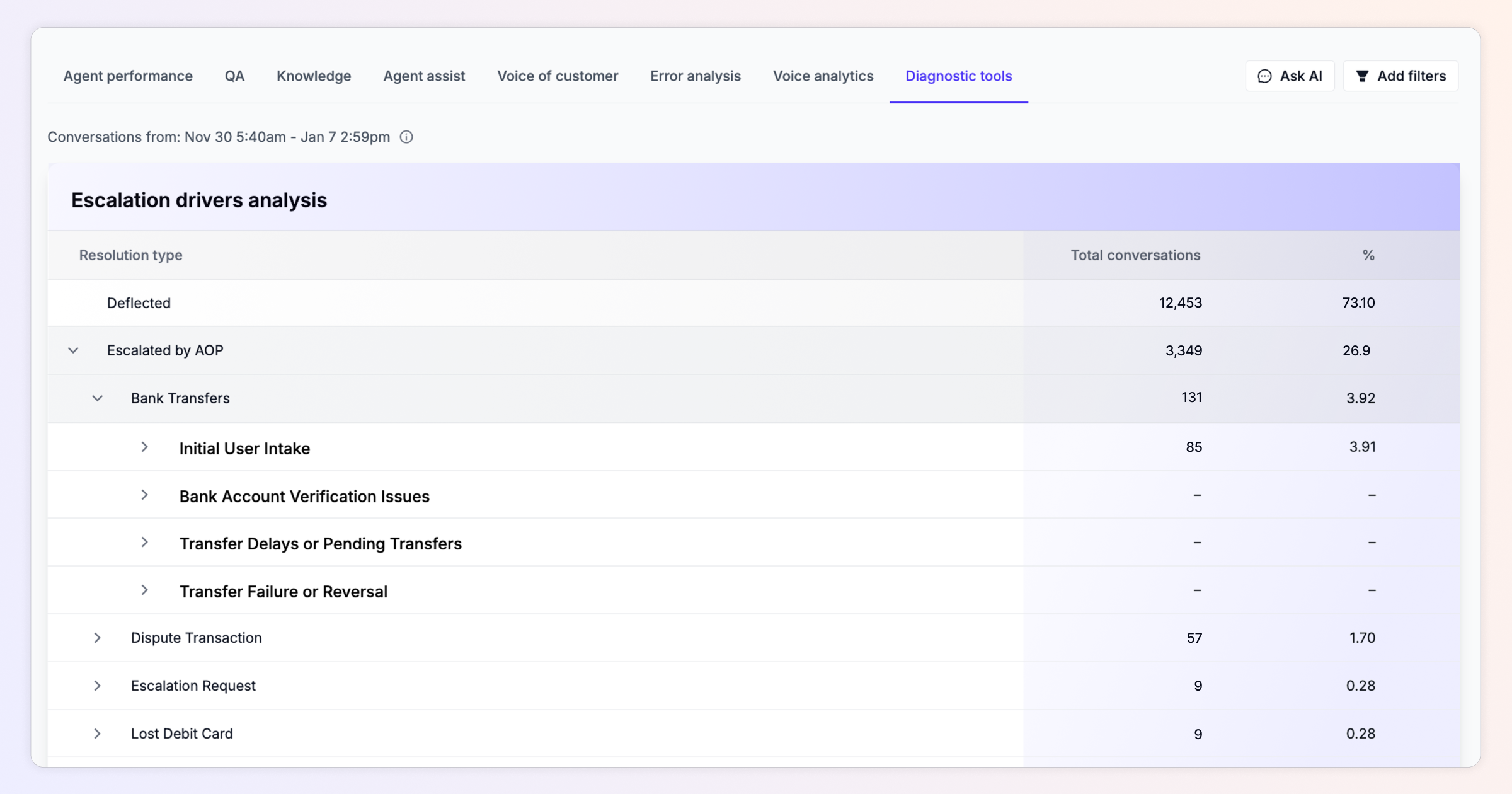
Escalation Drivers quantifies when conversations escalate from a Decagon agent to a human agent, aggregating the number of escalations by each guardrail and AOP. This highlights which rules trigger the most handoffs and helps you prioritize refinements for better deflection rates.

By viewing escalations as a percentage of total conversations, you can quickly identify cases where your agent should have reached full resolution but escalated unnecessarily. You can then review sample conversations to determine necessary updates to guardrails or AOPs. What once required hours of manual review can now be achieved in minutes.
AOP Flow Analysis: Validate and improve workflows

AOP Flow Analysis allows you to understand whether conversations are progressing through Agent Operating Procedures as expected and identify areas that impact workflows. Instead of reviewing conversations one by one, aggregate flow views reveal patterns instantly. Filter to the specific AOP and version you want to analyze, then see how many conversations make it to each step of the AOP. This visibility helps you identify unexpected drop-off points that signal refinement opportunities. 

High precision analytics powered by Decagon’s agent architecture

AOP Flow Analysis is powered by Decagon's unique agent architecture, which combines natural language instructions with structured nodes. Nodes ensure critical decision points are executed reliably. This structure allows us to treat nodes as reliable check points, enabling precise analytics and detailed workflow observability.

At scale, nodes reveal patterns across thousands of conversations in the AOP Flow Analysis view. At the conversation level, AOP Trace View uses nodes to uncover the exact sequence of logic that led to a specific outcome. Decagon's platform provides transparency and analytics to pinpoint exactly what matters, so every update you make drives measurable improvement.

Move from insight to action

Together, Escalation Drivers and AOP Flow Analysis complete the optimization flywheel. Across all of your conversations, Escalation Drivers helps you identify which guardrails and AOPs need attention. AOP Flow Analysis shows where conversations break down and why. Armed with these insights, you can optimize your AOPs with confidence and test performance before republishing.

This transforms hillclimbing from manual guesswork into a data-driven practice. Teams can move from insight to action in minutes instead of days, ensuring their agent continuously improves and delivers exceptional customer experiences.

Ready to accelerate your agent optimization? Book a demo to see how Decagon’s complete platform powers continuous agent improvement.

Blog

Climb higher: Introducing Diagnostic Tools for faster agent iteration

Introducing the newest feature in the Decagon Insights and Reporting suite, built to move you from insight to action.

AI agents are taking on increasingly complex tasks, from troubleshooting technical issues to processing returns with multiple dependencies. As these responsibilities grow, so does the challenge of maintaining production-ready quality. The gap between an agent's initial performance and the reliability customers expect can be substantial.

This is where hillclimbing becomes critical. Hillclimbing is the iterative process of improving agent performance through continuous optimization, and it is fundamental to building effective AI systems. Teams need to move quickly to maintain high-quality agents that keep pace with evolving customer needs and increasingly sophisticated use cases.

However, traditional hillclimbing is slow and manual. Agent builders deploy trial-and-error techniques to optimize agent behavior, manually sifting through interactions to identify patterns. This needle-in-the-haystack approach makes it difficult to prioritize which improvements will have the greatest impact on agent performance.

Introducing Diagnostic Tools

Today, we're launching Diagnostic Tools, the newest feature in Decagon's Insights and Analytics suite. Diagnostic Tools provide prescriptive insights to guide teams to the most important optimization opportunities, so they can accelerate improvements to their agent. With Diagnostic Tools, you can:

  • Focus optimization efforts by uncovering unexpected escalation behavior 
  • Validate AOP workflows to understand the actual paths conversations take, not just the happy path
  • Identify actionable next steps by deep-diving into flagged conversations 

Diagnostic Tools launches with two core features that work together to transform how teams optimize their agents: Escalation Drivers and AOP Flow Analysis.

Escalation Drivers: Pinpoint where to focus

Escalation Drivers quantifies when conversations escalate from a Decagon agent to a human agent, aggregating the number of escalations by each guardrail and AOP. This highlights which rules trigger the most handoffs and helps you prioritize refinements for better deflection rates.

By viewing escalations as a percentage of total conversations, you can quickly identify cases where your agent should have reached full resolution but escalated unnecessarily. You can then review sample conversations to determine necessary updates to guardrails or AOPs. What once required hours of manual review can now be achieved in minutes.

AOP Flow Analysis: Validate and improve workflows

AOP Flow Analysis allows you to understand whether conversations are progressing through Agent Operating Procedures as expected and identify areas that impact workflows. Instead of reviewing conversations one by one, aggregate flow views reveal patterns instantly. Filter to the specific AOP and version you want to analyze, then see how many conversations make it to each step of the AOP. This visibility helps you identify unexpected drop-off points that signal refinement opportunities. 

High precision analytics powered by Decagon’s agent architecture

AOP Flow Analysis is powered by Decagon's unique agent architecture, which combines natural language instructions with structured nodes. Nodes ensure critical decision points are executed reliably. This structure allows us to treat nodes as reliable check points, enabling precise analytics and detailed workflow observability.

At scale, nodes reveal patterns across thousands of conversations in the AOP Flow Analysis view. At the conversation level, AOP Trace View uses nodes to uncover the exact sequence of logic that led to a specific outcome. Decagon's platform provides transparency and analytics to pinpoint exactly what matters, so every update you make drives measurable improvement.

Move from insight to action

Together, Escalation Drivers and AOP Flow Analysis complete the optimization flywheel. Across all of your conversations, Escalation Drivers helps you identify which guardrails and AOPs need attention. AOP Flow Analysis shows where conversations break down and why. Armed with these insights, you can optimize your AOPs with confidence and test performance before republishing.

This transforms hillclimbing from manual guesswork into a data-driven practice. Teams can move from insight to action in minutes instead of days, ensuring their agent continuously improves and delivers exceptional customer experiences.

Ready to accelerate your agent optimization? Book a demo to see how Decagon’s complete platform powers continuous agent improvement.

Blog

Resources
/
Climb higher: Introducing Diagnostic Tools for faster agent iteration

Climb higher: Introducing Diagnostic Tools for faster agent iteration

January 14, 2026

AI agents are taking on increasingly complex tasks, from troubleshooting technical issues to processing returns with multiple dependencies. As these responsibilities grow, so does the challenge of maintaining production-ready quality. The gap between an agent's initial performance and the reliability customers expect can be substantial.

This is where hillclimbing becomes critical. Hillclimbing is the iterative process of improving agent performance through continuous optimization, and it is fundamental to building effective AI systems. Teams need to move quickly to maintain high-quality agents that keep pace with evolving customer needs and increasingly sophisticated use cases.

However, traditional hillclimbing is slow and manual. Agent builders deploy trial-and-error techniques to optimize agent behavior, manually sifting through interactions to identify patterns. This needle-in-the-haystack approach makes it difficult to prioritize which improvements will have the greatest impact on agent performance.

Introducing Diagnostic Tools

Today, we're launching Diagnostic Tools, the newest feature in Decagon's Insights and Analytics suite. Diagnostic Tools provide prescriptive insights to guide teams to the most important optimization opportunities, so they can accelerate improvements to their agent. With Diagnostic Tools, you can:

  • Focus optimization efforts by uncovering unexpected escalation behavior 
  • Validate AOP workflows to understand the actual paths conversations take, not just the happy path
  • Identify actionable next steps by deep-diving into flagged conversations 

Diagnostic Tools launches with two core features that work together to transform how teams optimize their agents: Escalation Drivers and AOP Flow Analysis.

Escalation Drivers: Pinpoint where to focus

Escalation Drivers quantifies when conversations escalate from a Decagon agent to a human agent, aggregating the number of escalations by each guardrail and AOP. This highlights which rules trigger the most handoffs and helps you prioritize refinements for better deflection rates.

By viewing escalations as a percentage of total conversations, you can quickly identify cases where your agent should have reached full resolution but escalated unnecessarily. You can then review sample conversations to determine necessary updates to guardrails or AOPs. What once required hours of manual review can now be achieved in minutes.

AOP Flow Analysis: Validate and improve workflows

AOP Flow Analysis allows you to understand whether conversations are progressing through Agent Operating Procedures as expected and identify areas that impact workflows. Instead of reviewing conversations one by one, aggregate flow views reveal patterns instantly. Filter to the specific AOP and version you want to analyze, then see how many conversations make it to each step of the AOP. This visibility helps you identify unexpected drop-off points that signal refinement opportunities. 

High precision analytics powered by Decagon’s agent architecture

AOP Flow Analysis is powered by Decagon's unique agent architecture, which combines natural language instructions with structured nodes. Nodes ensure critical decision points are executed reliably. This structure allows us to treat nodes as reliable check points, enabling precise analytics and detailed workflow observability.

At scale, nodes reveal patterns across thousands of conversations in the AOP Flow Analysis view. At the conversation level, AOP Trace View uses nodes to uncover the exact sequence of logic that led to a specific outcome. Decagon's platform provides transparency and analytics to pinpoint exactly what matters, so every update you make drives measurable improvement.

Move from insight to action

Together, Escalation Drivers and AOP Flow Analysis complete the optimization flywheel. Across all of your conversations, Escalation Drivers helps you identify which guardrails and AOPs need attention. AOP Flow Analysis shows where conversations break down and why. Armed with these insights, you can optimize your AOPs with confidence and test performance before republishing.

This transforms hillclimbing from manual guesswork into a data-driven practice. Teams can move from insight to action in minutes instead of days, ensuring their agent continuously improves and delivers exceptional customer experiences.

Ready to accelerate your agent optimization? Book a demo to see how Decagon’s complete platform powers continuous agent improvement.

AI agents for concierge customer experience

Get a demo