







Voice AI for call centers: What buyers need to know
January 14, 2026

Written by Ryan Smith
This guide covers what voice AI is, where it works best, what it costs, and how to evaluate vendors so you know which fits your needs best. Let’s build a framework to help you select workflows, set realistic ROI expectations, and get clarity on which vendor type fits your situation.
What is voice AI for call centers?
Voice AI for call centers uses natural language processing (NLP) and speech recognition to power virtual agents that understand and respond to customer inquiries in natural language. These AI-powered systems automate interactions without requiring human agents for every call.
Think of it as the evolution beyond those frustrating phone menus. Traditional Interactive Voice Response (IVR) systems force callers to press buttons and navigate rigid decision trees. Voice AI understands what callers actually say, responds naturally, and handles tasks from start to finish.
Voice AI also connects with existing business systems, like Salesforce, Zendesk, and internal databases. This integration means the AI knows who's calling before the conversation starts. It can pull up order history, account status, and previous interactions to personalize responses.
How voice AI processes a call
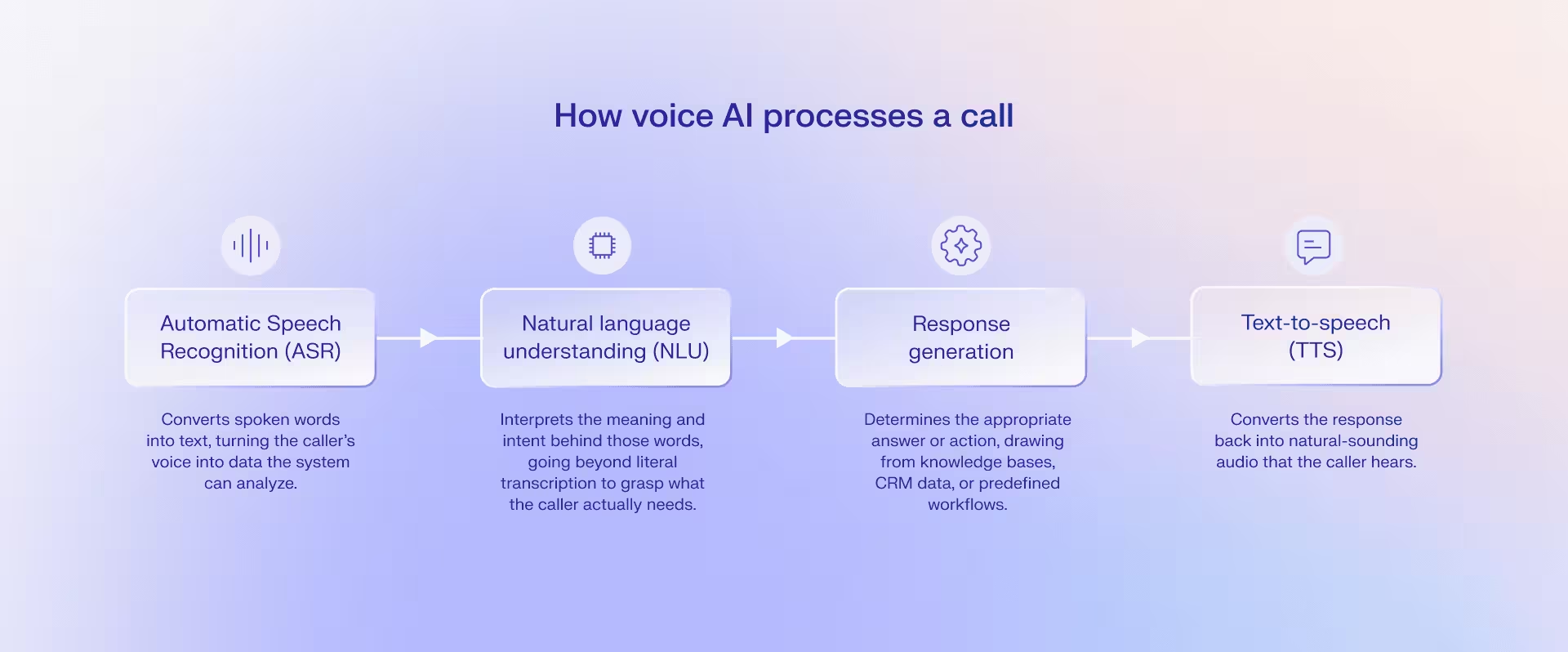
The technology works through a four-step process:
- Automatic speech recognition (ASR) converts spoken words into text, turning the caller's voice into data the system can analyze.
- Natural language understanding (NLU) interprets the meaning and intent behind those words, going beyond literal transcription to grasp what the caller actually needs.
- Response generation determines the appropriate answer or action, drawing from knowledge bases, CRM data, or predefined workflows.
- Text-to-speech (TTS) converts the response back into natural-sounding audio that the caller hears.
Modern systems powered by large language models (LLMs) handle synonyms, slang, accents, and everyday phrasing far better than earlier generations. They understand context, manage interruptions, and maintain the thread of a conversation across multiple turns.
Advanced conversational AI analyzes tone, pace, and word choice to detect caller sentiment during conversations. When frustration rises, the system can adjust its approach, simplifying explanations, offering faster paths to resolution, or escalating to a human agent before the situation deteriorates.
This capability remains imperfect. Nuanced emotional states and cultural differences in expression still challenge current voice AI systems. But the technology continues improving, and even basic sentiment detection helps route difficult calls appropriately.
How is AI used in call centers?
AI in call centers excels at structured, repeatable workflows where the inputs and outputs follow predictable patterns. Here's where AI delivers the strongest results today.
Scheduling
Appointment management represents one of voice AI's most mature use cases. The AI handles the entire booking lifecycle through natural conversation:
- Booking new appointments by checking availability, confirming times, and sending calendar invites without agent involvement.
- Rescheduling existing appointments when customers need to change dates, with the AI navigating calendar conflicts automatically.
- Canceling appointments and processing any associated policies around deposits, fees, or rebooking requirements.
- Sending reminders via outbound calls or messages to reduce no-show rates.
Healthcare practices, salons, repair services, and professional offices see particularly strong results here. The AI manages high volumes of routine scheduling calls, freeing staff to focus on patients or clients who walk through the door.
Billing and payments
Financial transactions require precision and security. Voice AI handles billing inquiries and payment processing while maintaining compliance standards:
- Processing payments by securely collecting card details through PCI-compliant voice interactions.
- Checking account balances and providing real-time information on amounts due, payment history, and upcoming charges.
- Generating and sending invoices based on caller requests or automated triggers.
- Explaining charges by pulling itemized details from billing systems and walking callers through line items.
- Setting up payment plans for customers who need flexibility, following predefined business rules.
The AI connects directly to payment processors and accounting systems. When a caller says "I want to pay my bill," the system pulls the balance, confirms the amount, collects payment information, processes the transaction, and sends a confirmation, all within a single call.
Customer authentication
Identity verification is critical for most support interactions. Before an agent (human or AI) can discuss account details, they need to confirm who's calling. Voice AI approaches authentication through several methods:
- Knowledge-based verification asks callers security questions tied to their account, such as the last four digits of their card, billing zip code, or recent transaction amounts.
- Voice biometrics analyzes unique vocal characteristics to verify identity passively during conversation, reducing friction for repeat callers.
- Multi-factor confirmation sends one-time codes via SMS or email that callers read back to the system.
Authentication design directly impacts resolution rates. Clunky verification flows frustrate callers and increase abandonment. Smooth authentication gets customers to the help they need faster, which improves satisfaction scores and reduces repeat calls.
Proactive engagement
Voice AI isn't limited to answering inbound calls. Outbound AI handles proactive customer communication at scale:
- Appointment reminders reduce no-shows by confirming upcoming bookings and offering easy rescheduling options.
- Payment due notifications alert customers before bills become overdue, improving collection rates while maintaining goodwill.
- Service updates inform customers about order status changes, delivery windows, or service interruptions.
- Renewal reminders prompt customers when subscriptions or contracts approach expiration.
- Survey and feedback collection gather customer input after service interactions while the experience remains fresh.
Proactive outreach works best for transactional communications where the message and potential responses follow clear patterns. Advanced sales conversations, or sensitive collections still benefit from human involvement, though AI can handle initial contact and qualification before handing off to human agents.
Where these use cases intersect
Real-world calls rarely fit neatly into single categories. A customer calling about a bill might need authentication first, then payment processing, then schedule a service appointment. Voice AI handles these multi-intent calls by recognizing transitions and maintaining context throughout the conversation.
The AI knows that the caller who just paid their bill and then asked "when can someone come fix my furnace?" needs scheduling help, not another payment prompt. This contextual awareness separates modern voice AI from the rigid phone trees of the past.
What are the benefits of AI for call centers?
Voice AI delivers measurable gains across cost reduction, customer satisfaction, and operational capacity. The benefits of conversational AI compound over time as the system learns from interactions and handles increasingly challenging scenarios. Here's what organizations actually see when they deploy voice AI effectively.
1. Automated conversations that feel natural
Voice AI replaces frustrating keypress menus with genuine conversation using natural language processing (NLP). Callers state their needs in plain language, and the system responds accordingly. No more "press 1 for billing, press 2 for support, press 3 to hear these options again."
This shift matters because customers abandon calls when navigation feels like work. Voice AI keeps them engaged by:
- Handling routine inquiries like store hours, order status, and policy questions without any hold time.
- Processing bookings and transactions through back-and-forth dialogue that confirms details naturally.
- Resolving simple issues end-to-end so callers get answers in minutes rather than waiting for the next available agent.
The result is faster resolution for customers and fewer repetitive calls consuming agent time.
2. Increased efficiency and scalability
Call centers face a math problem. Call volume fluctuates, spiking during product launches, seasonal peaks, or service outages, but staffing remains relatively fixed. Hiring for peak demand means overpaying during quiet periods. Hiring for average demand results in long hold times during volume surges.
Voice AI changes this equation. The technology scales instantly to match demand without the lag time of recruiting, hiring, and training new agents. Organizations using voice AI report:
- 65-95% cost reductions on calls the AI fully resolves, depending on use case complexity.
- Higher agent retention because staff handle interesting problems instead of answering the same questions hundreds of times daily.
- Consistent service levels during unexpected volume spikes that would otherwise overwhelm human teams.
3. 24/7 availability without out-of-hours staffing costs
Customer needs don't follow business hours. A billing question at 11 PM matters just as much to that caller as one at 2 PM. Traditional call centers either staff overnight shifts at premium rates or force customers to wait until morning.
Voice AI provides instant support at any hour. For global businesses serving multiple time zones, this capability eliminates the challenge of following-the-sun staffing models.
Around-the-clock availability also captures opportunities that would otherwise slip away. A customer ready to book an appointment or make a purchase at midnight can complete that transaction immediately, rather than cooling off overnight and reconsidering.
4. Contextual understanding that reduces friction
Modern voice AI goes beyond recognizing keywords. The technology grasps intent, handles interruptions gracefully, and maintains context across conversation turns.
When a caller says, "Actually, never mind the refund, can you just exchange it instead?" the AI understands the pivot and adjusts accordingly. It doesn't force callers to start over or repeat information they've already provided.
This contextual awareness enables:
- Personalized responses that reference the caller's history, preferences, and account status.
- Smooth handling of mid-sentence corrections without losing the thread of conversation.
- Relevant follow-up questions that gather necessary information efficiently rather than running through generic scripts.
Callers notice the difference. Interactions feel like conversations with someone who's paying attention rather than battles with a system that doesn't listen.
5. Agent assistance during live calls
Voice AI doesn't just replace human agents – it makes them better at their jobs. Agent assist tools analyze conversations in real time and surface relevant information from knowledge bases while the call is happening.
When a human agent takes an escalated call, the AI:
- Provides instant context by summarizing what the caller already discussed with the AI before escalation.
- Suggests responses based on similar past interactions and successful resolutions.
- Pulls relevant documentation from knowledge bases so agents don't waste time searching.
- Transcribes the conversation in real time, eliminating manual note-taking and ensuring accurate records.
This support reduces average handle time and improves first-call resolution rates. Agents spend less time hunting for information and more time actually helping customers. For many organizations, agent assist delivers the fastest path to ROI because it improves outcomes without requiring customers to interact with AI directly.
6. Data and analytics that drive continuous improvement
Every voice AI interaction generates structured data. Unlike traditional calls that produce only recordings requiring manual review, AI-handled calls automatically capture intent, sentiment, resolution status, and conversation flow.
This data enables:
- Trend identification that surfaces emerging issues before they become widespread problems.
- Performance optimization by revealing which conversation paths lead to successful resolutions and which create friction.
- Compliance documentation through automated logging of required disclosures, consent confirmations, and authentication steps.
- Product and service insights from aggregated customer feedback that would otherwise remain buried in call recordings.
The analytics loop compounds voice AI's value over time. Each interaction teaches the system something new, and the data helps organizations spot opportunities to automate additional workflows or improve existing ones.
Best practices for using voice AI
Deploying voice AI requires clear guidelines around legal compliance, technical integration, security, and human-AI collaboration.
Understand legal restrictions before you launch
Voice AI operates under regulations that vary by region, industry, and use case. Getting this wrong creates legal exposure that no efficiency gain justifies.
- AI voice classification rules are now explicit in the US. The FCC's February 2024 ruling confirmed that AI-generated voices, including voice cloning and synthetic speech, qualify as "artificial" under the TCPA. This means AI-initiated calls require the same prior express consent as traditional robocalls, with penalties of $500–$1,500 per violation and no cap on total damages. Similar regulations exist in the EU, UK, and other markets.
- Disclosure and identification rules require AI voice calls to state the identity of the responsible party at the start of the message. Where calls constitute telemarketing, callers must also provide opt-out mechanisms.
- Consent requirements have tightened but remain in flux. Some jurisdictions require all-party consent, while others need only single-party consent. Voice AI systems must comply with notification and data retention rules. Businesses must obtain prior express written consent for telemarketing calls using AI voices, honor opt-out requests within 10 business days, and maintain detailed consent records.
- Industry-specific regulations add requirements: HIPAA for healthcare, PCI-DSS for financial services, plus sector-specific frameworks for telecommunications. Build compliance into workflows from the start.
Test, review, iterate, expand
- Start with contained use cases. Select workflows with clear inputs, predictable paths, and measurable outcomes, such as scheduling, balance inquiries, and order status. Complicated multi-department issues can come later.
- Plan for real-world audio variation. Production calls include background noise, poor connections, accents, and mumbling. Test with real audio samples and build fallback paths for low-confidence parsing.
- Design authentication carefully. Clunky verification frustrates callers and tanks resolution rates. Consider voice biometrics, progressive authentication for sensitive actions, and clear escalation paths.
- Establish feedback loops early. Monitor conversations closely, tag problems by category, and iterate rapidly. The first weeks reveal edge cases testing missed.
Integrate with your existing tech stack
An isolated AI agent that can't access your CRM, billing system, or order database delivers limited value.
- Map integration requirements early. Identify which systems the AI reads from and writes to. Pre-built connectors for Salesforce, Zendesk, and ServiceNow accelerate deployment; custom integrations require development time.
- Ensure real-time data access. A voice agent quoting yesterday's balance frustrates callers. Evaluate API latency and caching strategies.
- Plan for bidirectional data flow. The AI should pull context and push interaction records back to keep customer histories complete.
- Verify telephony compatibility. Some platforms require specific SIP trunk configurations or work only with certain cloud phone systems.
Prioritize security and compliance from day one
Voice AI handles sensitive customer information. Shortcuts create compounding risks.
- Data encryption should cover information in transit and at rest, including recordings, transcripts, and extracted data.
- Access controls must limit who can view conversations, modify AI behavior, and export data, using role-based permissions.
- Audit logging tracks what the AI said, what actions it took, who reviewed conversations, and configuration changes.
- Data retention policies should define how long you keep recordings, when data gets anonymized, and how you handle GDPR access requests.
- Vendor security assessments matter. Review SOC 2 reports, penetration testing practices, and data storage locations. Include security requirements in contracts.
Position AI as a partner to human agents, not a replacement
The most successful deployments augment human capabilities rather than eliminate roles.
- Route advanced issues to humans through clear escalation triggers. Emotional distress, critical problems, and high-value customers should flow to equipped agents.
- Provide AI-generated context on transfers. Summaries of previous conversations, account details, and suggested next steps prevent customers from repeating themselves.
- Use AI for repetitive tasks that burn out agents—password resets, balance checks, appointment confirmations. This frees agents for work requiring judgment and empathy.
- Involve agents in AI training. Frontline staff understand customer pain points better than anyone. Their input improves the system and builds buy-in.
- Communicate transparently about AI's role. Agents who understand the strategy embrace it; customers who know they can reach humans trust the AI more.
How Decagon Voice supports call centers
Decagon Voice brings the same action-oriented AI that powers chat and email support to phone conversations. Rather than building voice as a standalone product, Decagon extends its unified platform so organizations can define logic once and deploy it across every customer channel.
One platform, every channel
Most voice AI vendors require separate configurations for phone, chat, and email, creating silos with different logic, knowledge bases, and capabilities. Customers notice inconsistent answers depending on how they reach out.
Decagon's Agent Operating Procedures (AOPs) define workflows in natural language that compile to code. Write an AOP for processing refunds that works identically whether a customer calls, chats, or emails. This unified architecture means:
- Shared knowledge bases across phone, chat, and email agents.
- Consistent business rules, including refund policies, authentication requirements, and escalation triggers, apply across all channels.
- Unified analytics showing interactions across all channels in one view.
Built for action, not just conversation
Decagon Voice agents complete tasks, not just answer questions. A caller rescheduling a delivery doesn't hear "I'll transfer you." The AI checks available windows, confirms the new time, updates the order system, and sends confirmation within the same call.
The platform integrates with CRMs like Salesforce, helpdesks like Zendesk, and custom systems through APIs, letting agents pull context before responding and push updates after acting.
Observability and testing built in
Production voice AI requires visibility and confidence that changes won't break workflows. Decagon provides both:
- Watchtower monitors conversations continuously, flagging anomalies and tracking sentiment before issues scale
- Testing infrastructure simulates conversations and runs regression tests before production deployment
- Trace view shows exactly how the AI reached each decision, such as which AOPs fired, what data it retrieved, and why it chose specific responses
White-glove partnership for enterprise deployment
Decagon pairs customers with dedicated Agent Product Managers who understand both the technology and contact center operations. These teams design authentication flows, identify high-impact workflows to automate first, and configure telephony integrations, targeting production deployment in weeks, not months.
Making the call
Voice AI has moved from experimental to production-ready. Organizations achieving 70%+ resolution rates and significant cost reductions prove the technology works when implemented thoughtfully.
Success depends on decisions that vendor demos rarely highlight: authentication design, latency budgets, integration architecture, and the balance between AI and human agents. Feature checklists matter less than treating voice AI as an operational transformation.
Here are four questions to guide your evaluation:
- Which workflows should you automate first? Start with high-volume, structured interactions that the AI can fully resolve without escalation.
- Does your vendor match your channel strategy? Voice-first specialists offer tuned stacks; omnichannel platforms like Decagon provide unified logic across every touchpoint.
- How will you measure success? Define resolution rate, cost per interaction, and satisfaction targets before launch.
- What does the human-AI handoff look like? Smooth escalations with full context determine whether challenging calls resolve successfully.
Voice AI isn't about replacing your contact center. It's about freeing your team to focus on moments that require human judgment, empathy, and creativity.
Recent posts
Introducing automatic optimization and Root Cause Analysis
Today, we’re excited to announce two new capabilities to help you rapidly improve your agent’s performance.