How conversational AI works with NLP, NLU, and NLG technologies
Posted on November 2, 2025


Article
“Generative AI" and "conversational AI" are often used almost interchangeably. So, what's the actual difference between conversational AI and generative AI when it comes to customer support?
Here's the simple breakdown:
- Conversational AI is the complete system. It's the technology designed to understand, process, and respond to human dialogue. Its main job is to manage the entire back-and-forth flow of a conversation, understand context, track what was said earlier, and figure out the user's intent.
- Generative AI is a powerful component that creates new content. It's the engine that can write text, create images, or generate code. It can go beyond chatting with a user to write an essay, a marketing email, or even code.
Modern, generative AI-powered chatbots are a type of conversational AI, but not all conversational AI uses generative AI.
But how does it all work?
How does conversational AI work?
Conversational AI processes requests through a step-by-step pipeline. It uses Natural Language Processing (NLP) to understand input, Natural Language Understanding (NLU) to detect the user's intent, dialogue management to track the conversation, and Natural Language Generation (NLG) to create a human-like response.
Many explanations stop at the surface-level answer of "it just predicts the next word." This is frustrating if you have practical questions that theory doesn't answer, such as:
- How does a voice agent respond in less than a second without that awkward lag?
- How does it keep answers on-brand and avoid "weird" or wrong responses?
- How does the same AI agent handle interactions across chat, voice, and email without losing context?
Here's a practical demo of how AI assistance for customer service works as a continuous loop:
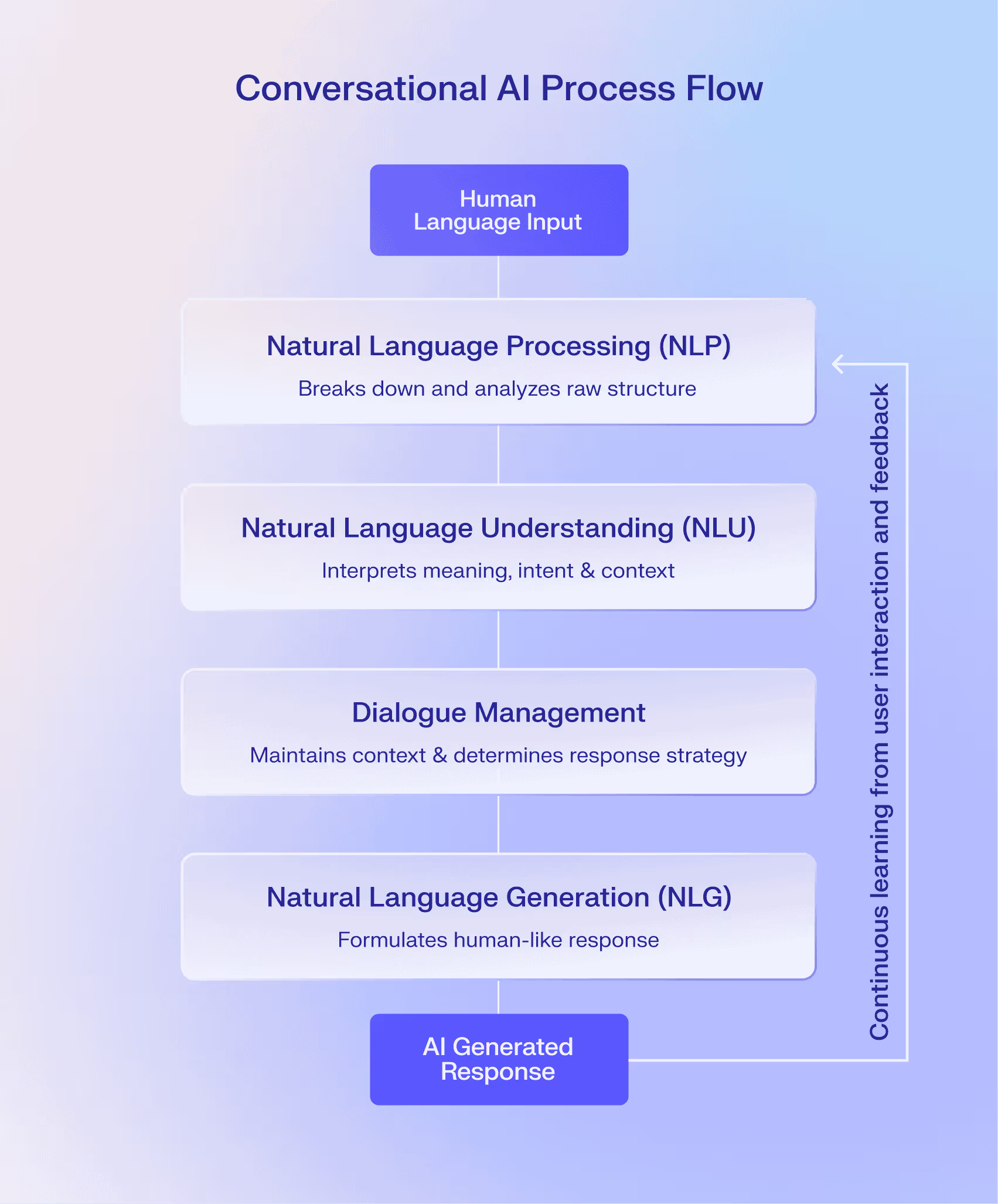
- Natural Language Processing (NLP) first breaks down and analyzes the raw structure of the human language input.
- Natural Language Understanding (NLU) then interprets the meaning, identifying the user's specific intent and context.
- Dialogue management acts as the brain of the operation, maintaining the conversation's context over multiple turns and determining the right response strategy.
- Natural Language Generation (NLG) takes the system's decision and formulates a helpful, human-like response.
- A continuous learning loop allows the AI to get smarter from user interactions and feedback, improving its accuracy over time.
Types of conversational AI technology
While "conversational AI" is often used as a single term, the technology exists on a spectrum. The type of conversational AI technology you use depends on the job you need it to do.
- Traditional chatbots: These are the original rule-based systems. They follow rigid, predefined decision trees and are limited to specific scenarios. They are highly predictable but can't handle unexpected questions.
- Generative AI chatbots: These systems use large language models (LLMs) to create dynamic, context-aware responses. They can manage complex, open-ended conversations and don't rely on a script.
- AI agents: Going beyond just chatting, AI agents are autonomous systems that can perform tasks, make decisions, and interact with multiple systems to take action on a customer's behalf.
- Virtual assistants: These are your familiar helpers like Siri or Alexa. They are typically voice-enabled and designed to manage personal tasks, answer questions, and integrate with various services and smart devices.
- Agent Assist (AI copilots): This technology works as a partner to your human support team. It provides real-time suggestions, information retrieval, and response drafts to help human agents resolve issues faster and more accurately.
Common ways to use conversational AI
Conversational AI is a practical tool that businesses have already started using to improve efficiency and create better customer experiences. You'll find it working behind the scenes in many ways, streamlining processes and providing immediate help.
Here are some of the most common and impactful applications:
- Automate customer support: This is the most popular use. AI agents can instantly handle common questions (FAQs), order tracking, basic troubleshooting, and all of the tier-1 support queries that would otherwise create a long wait time.
- Provide omnichannel support: This allows you to maintain one consistent, intelligent conversation with a customer as they move across web chat, mobile apps, social media, and messaging platforms.
- Schedule appointments: Instead of back-and-forth emails, the AI can manage calendar availability, book appointments, send confirmations, and even handle rescheduling requests automatically.
- Send reminders: AI can send proactive notifications for appointments, upcoming payments, service renewals, or any follow-up actions based on a user's preferences.
- Qualify leads: On a website, an AI agent can engage potential customers, gather initial information, assess their needs, and route high-intent, qualified prospects directly to the right sales team.
- Enable text-to-speech (for accessibility): This is crucial for inclusivity. By enabling voice interactions, you support visually impaired users and provide a hands-free experience for customers who are multitasking.
- Offer multilingual support: AI can automatically detect a user's language and respond in kind, instantly breaking down barriers for global customers.
- Collect and analyze data: Every conversation is a source of insight. AI can gather customer feedback, identify emerging trends (like a new bug or a popular feature request), and extract key insights from conversation patterns.
How best to implement conversational AI for your customer support
To ensure a successful deployment, focus on a thoughtful, step-by-step approach. This will help you avoid common challenges and get a return on your investment faster.
Here is a practical checklist for implementing conversational AI effectively:
- Define your goals first. Clearly outline what you want the AI to accomplish. Are you trying to reduce wait times, increase 24/7 support, or automate refunds? Your Key Performance Indicators (KPIs) should be specific, like "increase deflection rate to 75%" or "resolve common order-tracking issues without an agent."
- Start with high-volume, low-complexity queries. Identify the most repetitive, high-volume questions your support team handles, like "Where is my order?" or "What's your return policy?", and automate those first.
- Design natural, on-brand conversations. The AI's personality should align with your brand voice. Design conversation flows that feel natural and helpful, not robotic or rigid.
- Implement a smooth handoff to human agents. This is critical. For complex or sensitive issues, the AI must be able to escalate the conversation to a human agent smoothly, passing along the context so the customer doesn't have to repeat themselves.
- Continuously train and refine the AI. Use real conversation data and customer feedback to continuously train, refine, and improve the AI's answers and understanding.
- Integrate with your existing systems. To be truly effective, your AI agent must integrate with your CRM, order management system, or other support systems. This is how it moves from just chatting to taking action.
- Establish clear escalation paths and fallback options. What happens if the AI doesn't know the answer or the system is down? Have a clear fallback strategy in place to prevent a dead-end experience.
- Monitor performance and satisfaction. Keep a close eye on your metrics (like deflection rate, handle time, and resolution speed) and, most importantly, on customer satisfaction (CSAT) scores.
The future of conversational AI in customer experience
The journey of conversational AI is still unfolding. We are seeing it evolve far beyond simple, rigid chatbots into sophisticated systems that can truly understand context, emotion, and nuance.
This rapid advancement is powered by the tighter integration of Natural Language Processing (NLP), Natural Language Understanding (NLU), and Natural Language Generation (NLG). Together, these technologies are creating interactions that feel less like talking to a machine and more like having a genuinely helpful conversation.
At Decagon, we are at the forefront of this transformation. We build generative AI agents that can handle higher-value, complex tasks, freeing your human team to focus on their most strategic work. Our platform is designed to be powerful yet non-technical, empowering your team to deploy sophisticated agents that truly enhance the customer experience.
Ready to see how conversational AI can revolutionize your customer support?

Start improving your workflow with Decagon
With Decagon, CX teams don’t have to guess whether a change will improve CSAT or deflection. They can move quickly, measure what matters, and act on what works.
Join us
There are very few places where you can prototype with frontier LLMs, ship to production in days, and watch users engage with the systems you built—all while owning the entire stack, from intent parsing and tool usage to API integration and observability. This role at Decagon is one of those places.
From my own experience working across both agent development and broader engineering initiatives at Decagon, I’ve seen firsthand how uniquely impactful this work can be. Whether I’m building intelligent workflows for customers or designing infrastructure that supports our agent platform, it’s rare to find an environment where the work transitions from concept to production within days, actively powering user experiences and transforming how businesses operate.
If you’re looking for a role where you can:
- Build at the frontier of LLMs, automation, and user interaction
- Deploy AI agents that solve high-value business use cases across industries including retail, travel and hospitality, fintech, edtech, and more
- Work directly with customers on high-impact use cases
- Ship fast, iterate constantly, and own your work from idea to production
- Join a fast-moving, collaborative team solving real-world challenges with AI
We’d love to hear from you!
.png)

.svg)

.svg)

.svg)

.svg)

.svg)

.svg)

.svg)
The AI concierge for every customer.