What we’ve learned about designing AI-ready CX teams
Posted on March 23, 2026

Article
After working with hundreds of CX teams implementing AI agents, we find that customers often ask us how to staff and structure the team so the agent launches smoothly and keeps improving over time.
Selecting the right technology is only the first step. Organization design determines how easily CX can coordinate with product and engineering to plan iteration cycles. Our observation is that the most successful teams treat the agent like a product, with clear role ownership and a consistent process for improving performance over time.
Scale individual contribution to system-level impact
In traditional support environments, impact happens at the conversation level. Experienced operators resolve complex issues, escalate edge cases, and surface recurring themes through manual review.
With an AI agent in place, the work shifts to designing how issues are resolved at scale. CX operators become CX architects, defining agent logic, escalation workflows, tone guidelines, and guardrails. With Decagon’s natural language Agent Operating Procedures (AOPs), business teams can translate customer expertise into workflow logic that drives system-level improvements. Teams can review performance across thousands of conversations and use those patterns to prioritize what to improve next.
Key operating patterns of AI-ready teams
Across deployments, we see the most successful teams share a consistent set of operating principles.
First is clear ownership of agent performance. In most deployments, that looks like a dedicated AI Programs Lead who is accountable for outcomes and iteration. They own prioritization, coordinate cross-functional inputs, and report business metrics. In practice, they run quarterly planning sessions to discuss new workflows and expansion into additional channels and surfaces to extend the agent’s reach. They also document a clear process for reviewing and approving workflow changes, balancing both speed and governance.
Second is building AI literacy across the organization. AI readiness requires more than knowing how to use the Decagon platform. Successful teams invest in broader training that builds shared understanding of how AI systems work, how to write effective prompts, and how knowledge and policies inform AI behavior. This is a core focus of Decagon University. Through live training and hands-on exercises, we help non-technical teams learn the fundamentals of prompt engineering and build the skillset to manage agents effectively.
Third is progress over perfection. AI readiness doesn’t mean that launches are always perfect. It’s more important to be able to learn safely in production through an improvement loop. High-performing teams set a regular cadence to review agent performance, identify gaps, and refine workflows, using live data to decide what gets built next. Over time, this discipline compounds as each update improves the agent and reduces repeat issues.
Typical roles in an AI-native CX organization
Most CX orgs don’t need a fully staffed AI team on day one. Early on, teams can distribute new responsibilities across existing owners based on their areas of expertise. As the program ramps up, those responsibilities typically formalize into more distinct roles, although titles may vary by organization.
This AI programs team integrates directly with the human support organization, operating in a parallel capacity. In some companies, CX SMEs align with product lines or business units. In others, they align to channels– chat, voice, and email. The right structure depends on company context, stage of adoption, and product complexity.
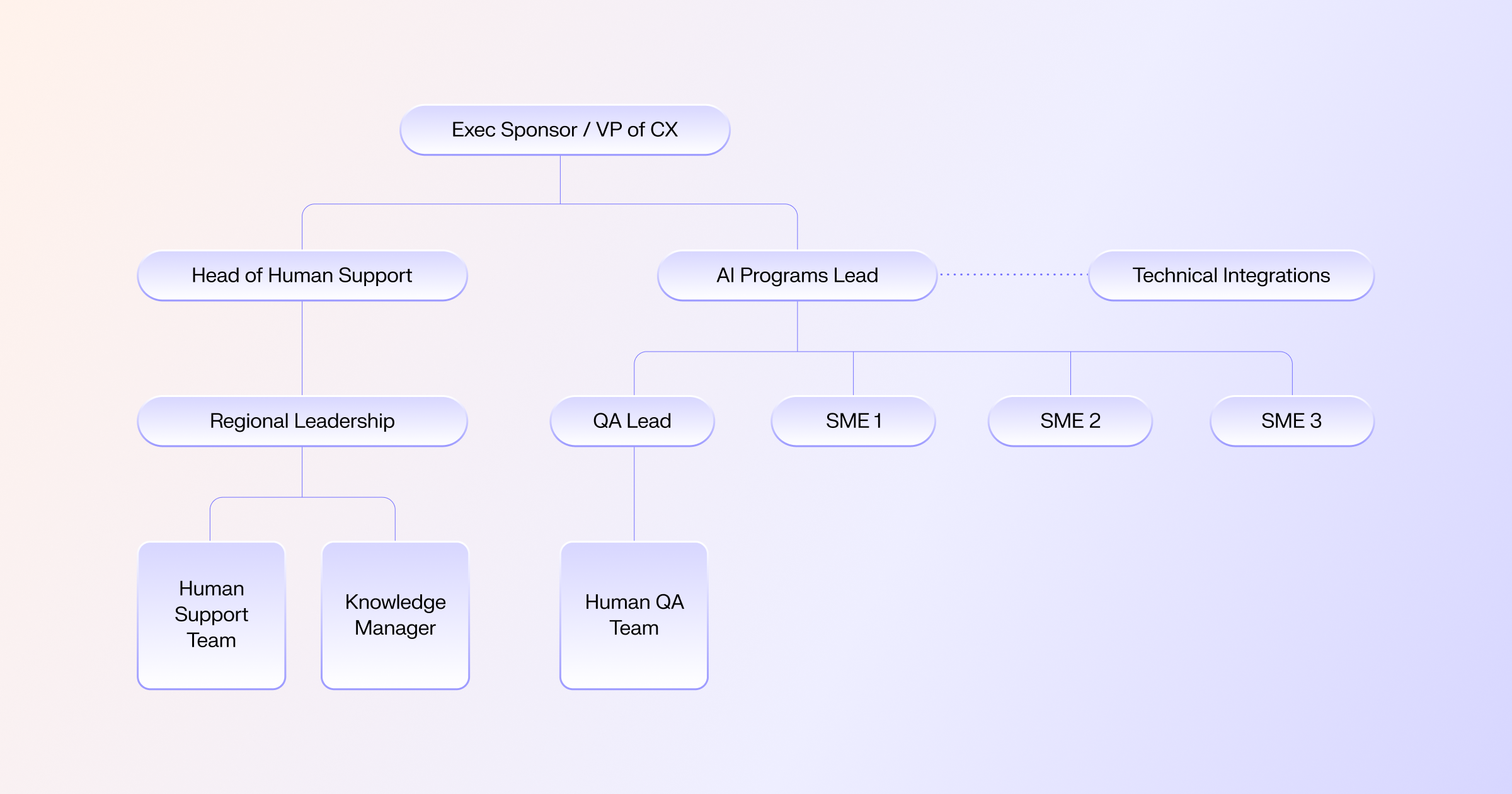
At the strategic layer, an executive sponsor provides oversight and ensures alignment with broader business goals. The AI Programs Lead serves as the agent owner and primary point of contact for the Decagon team, prioritizing AOP rollouts and managing performance metrics. This role requires a mix of capabilities:
- Business and technical literacy, with working comfort around APIs, data flows, and system architecture.
- Strong cross-functional relationships, with the ability to influence and drive alignment across stakeholders.
- Clear prioritization and program management skills, grounded in a data-backed mindset.
Within the system-building layer, CX SMEs lead AOP authoring, often writing detailed design documents for new journeys and escalation logic. This responsibility often starts as a part-time focus and ramps toward full-time as the number of AOPs grows. These individuals are typically strong individual contributors with cross-functional influence.
A Knowledge Manager, usually an existing role, maintains help center content, writes snippets, and reviews knowledge suggestions to keep the knowledge base accurate and usable by the agent. It’s also common to have access to a technical or integrations lead to coordinate API exposure and tool development across the support stack.
Quality assurance also expands in scope. Existing QA teams commonly extend coverage to include both human and AI interactions. With analytical tools like Watchtower, they analyze trends across thousands of interactions, identifying repeated gaps and opportunities for improvement.
CX as the role model for org-wide AI adoption
In many enterprises, CX is the first function to deploy AI in production at scale. As a result, how CX structures ownership, iteration, and enablement often becomes the reference point for the rest of the company.
For leaders thinking about the next phase, the focus shifts from launching an agent to building the capability to evolve it. That includes standardizing the process of rolling out new AOPs and adopting versioning and testing best practices so additional use cases and improvements can be rolled out safely.
If you’re thinking about how to structure your team and processes around AI agents, book a demo to start a conversation with our team.

Start improving your workflow with Decagon
With Decagon, CX teams don’t have to guess whether a change will improve CSAT or deflection. They can move quickly, measure what matters, and act on what works.
Join us
There are very few places where you can prototype with frontier LLMs, ship to production in days, and watch users engage with the systems you built—all while owning the entire stack, from intent parsing and tool usage to API integration and observability. This role at Decagon is one of those places.
From my own experience working across both agent development and broader engineering initiatives at Decagon, I’ve seen firsthand how uniquely impactful this work can be. Whether I’m building intelligent workflows for customers or designing infrastructure that supports our agent platform, it’s rare to find an environment where the work transitions from concept to production within days, actively powering user experiences and transforming how businesses operate.
If you’re looking for a role where you can:
- Build at the frontier of LLMs, automation, and user interaction
- Deploy AI agents that solve high-value business use cases across industries including retail, travel and hospitality, fintech, edtech, and more
- Work directly with customers on high-impact use cases
- Ship fast, iterate constantly, and own your work from idea to production
- Join a fast-moving, collaborative team solving real-world challenges with AI
We’d love to hear from you!


.svg)

.svg)

.svg)

.svg)

.svg)

.svg)

.svg)
The AI concierge for every customer.