Decagon Product Foundations
Start learning now
Fill out the form to get started on your AI CX Specialist Certification
Start learning now
Fill out the password to get started on your AI CX Architect Certification (customers only).

Evolving your agent with Versioning and gradual rollout
Top takeaways from this module:
- Agent Versioning brings CI/CD practices to AI agents
- Traffic splits allow you to run experiments between versions:
- Governance scales with your needs
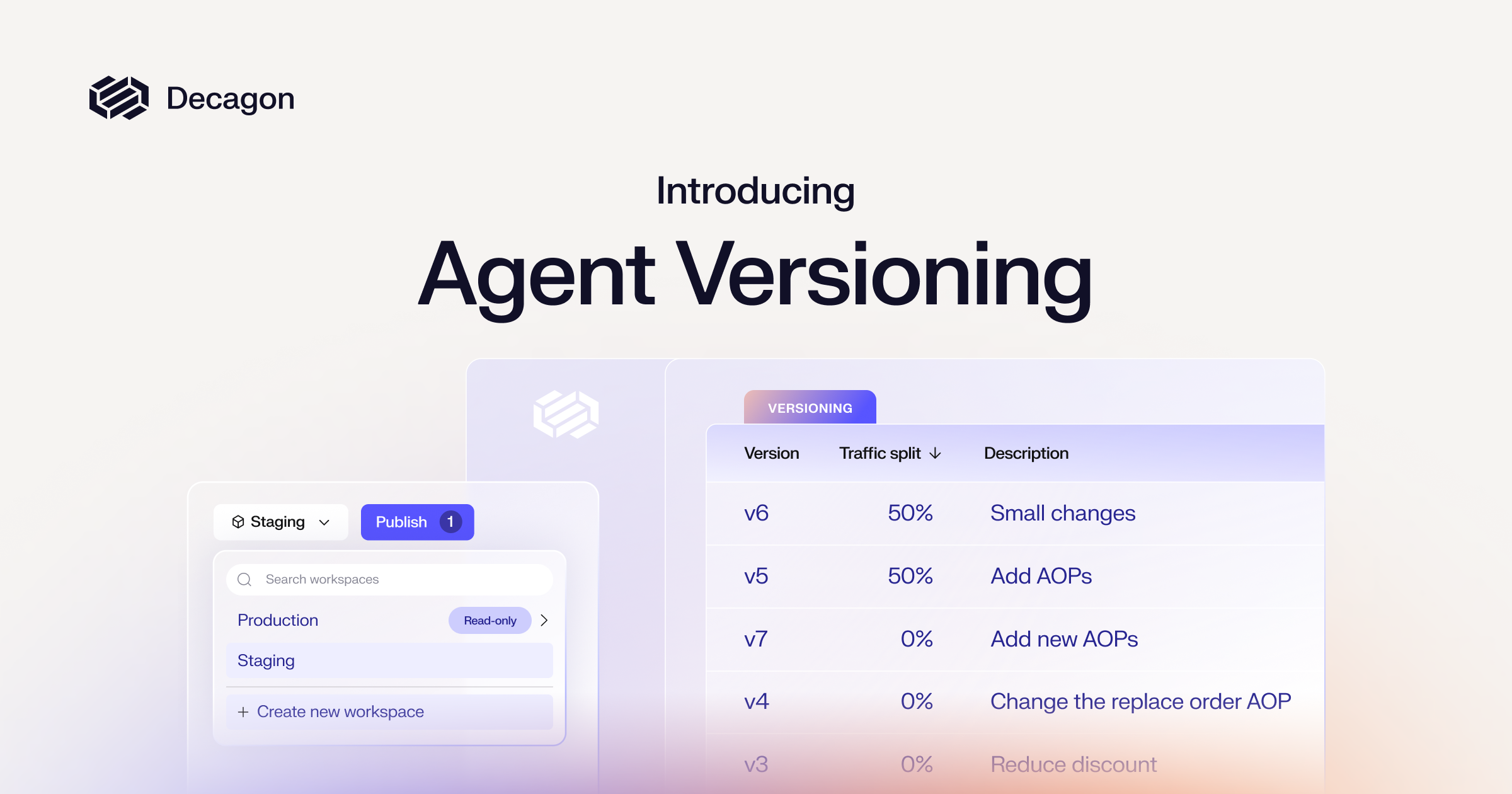
Your AI agent shouldn't stay frozen in time, it should evolve with the same rigor and control that software teams bring to product development. Agent Versioning applies CI/CD discipline to your Decagon agent, enabling safe collaboration, confident iteration, and continuous improvement.
Decagon makes versioning natural. Every change you make to AOPs, tools, or guidelines – whether in GitHub or the Decagon console – is tracked as a versioned commit. This creates a clear audit trail and lets you iterate without impacting your live agent. Versions are saved to gated workspaces that mirror Git branches, so teams can work in isolated environments without overwriting each other's progress.
When you're ready to roll out a new version, you have full control over how it reaches customers. Create a new version, split traffic between the old and new, and let Decagon randomize the distribution. Once live, you'll see performance data for each version. If results are positive and statistically significant, roll out fully. If not, roll back, learn, and test a new hypothesis.
Versioning provides governance that scales with your needs. Every change is auditable by default, with optional alerts, Git diffs, branch protections, and staging environments for formal testing and release gates.
With this, you can make experimentation part of your team’s rhythm, not something you only do once a quarter. The more ideas you test, the faster you’ll learn what moves the needle.