The real difference between agentic AI and generative AI
Posted on April 1, 2026

Article
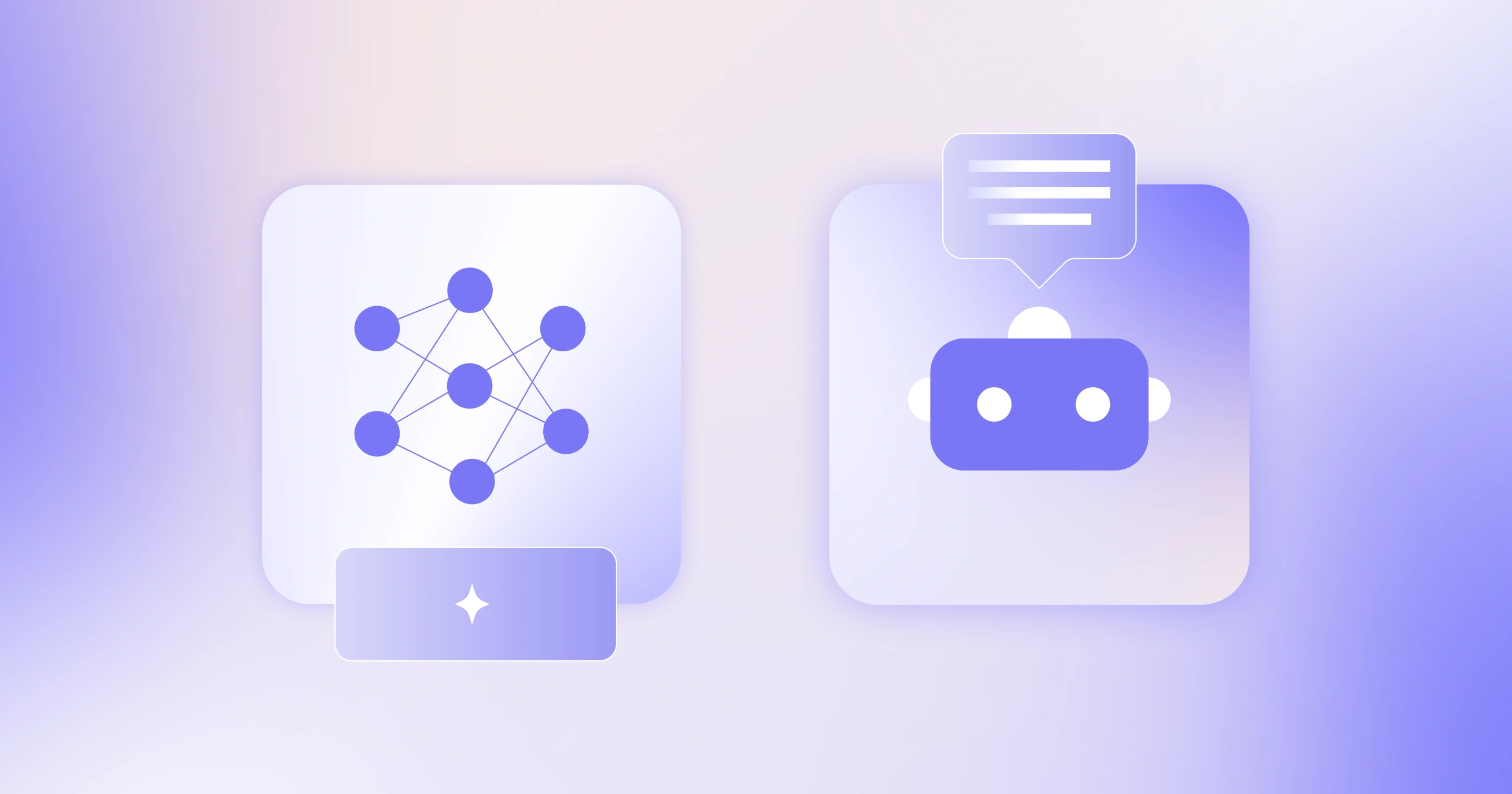
Generative AI is a content creator. It produces text, images, and code based on prompts. Agentic AI is a goal-driven doer. It plans, reasons, takes action across systems, and adapts on the fly with minimal human direction.
The two aren't rivals. Generative AI often powers the reasoning inside agentic systems. One provides the intelligence; the other puts it to work.
But plenty of products marketed as "AI agents" are really just language models with better prompting. Knowing the difference between genuine autonomy and a dressed-up prompt-response loop determines whether your AI investment delivers real outcomes or just more text.
Generative AI vs agentic AI
Generative AI is a category of artificial intelligence that creates new content from prompts. It generates text, images, code, music, and video by predicting what comes next based on patterns learned during training. Every major large language model (LLM), including GPT-4, Claude, and Gemini, falls into this category.
Agentic AI is a category of artificial intelligence that pursues goals through autonomous, multi-step action. It breaks objectives into tasks, decides which tools to use, interacts with external systems, and adjusts its approach based on what it learns along the way. An agentic system doesn't wait for instructions at every step. It receives a goal and works toward it.
The distinction comes down to creation versus action. Generative AI produces an output and stops. Agentic AI produces an outcome by chaining decisions, tools, and actions together until the job is done.
These two categories aren't separate technologies competing for the same job. Generative AI often serves as the cognitive engine within agentic systems. The LLM handles language understanding, reasoning, and response generation. The agentic framework wrapped around it handles planning, memory, tool orchestration, and execution.
Where the lines blur
Not every system fits neatly into one category. ChatGPT with plugins enabled can browse the web and run code, which looks like tool use. But it still operates in a prompt-response loop. It doesn't independently decompose goals, maintain long-term state, or self-correct across a multi-step workflow without human direction at each turn.
This is where vendor claims get muddy. Many products marketed as "AI agents" are LLMs with API access and well-crafted system prompts. They can call a tool when asked, but they lack the planning, memory, and autonomous decision-making that define true agentic behavior.
Three observable traits separate real agentic systems from advanced prompting:
- Goal decomposition. The system breaks a high-level objective into subtasks without being told each step.
- Persistent state and memory. The system tracks context across interactions and learns from previous outcomes.
- Autonomous tool selection. The system decides which external tools or APIs to call, when to call them, and how to interpret the results, with appropriate guardrails controlling what actions it can take.
Generative AI
As we've seen already, generative AI creates new content from input prompts. Every interaction follows the same pattern: input in, content out. Ask ChatGPT to write a product description, and you get a product description. Ask Midjourney to create a logo concept, and you get an image. Ask GitHub Copilot to complete a function, and you get code. The model doesn't then publish the description, send the logo to your designer, or deploy the code. It creates and waits for your next instruction.
What generative AI does well
Generative AI is artificial intelligence that works best for discrete, creative, and knowledge-intensive tasks where the goal is a single deliverable. Gen AI models are trained to predict what comes next in a sequence, such as the most likely next word, pixel, or token, given everything that came before. That prediction engine is what makes them so good at producing content that reads, looks, or functions like something a human would create.
- Writing and editing. Drafting emails, blog posts, reports, product copy, and social media content. Summarizing long documents into key points. Translating text across languages while preserving tone.
- Code generation. Producing code snippets, debugging existing scripts, explaining technical concepts, and autocompleting functions within development environments.
- Visual content. Creating images, illustrations, design mockups, and video clips from text descriptions. Tools like DALL-E, Midjourney, and Stable Diffusion have made this accessible to non-designers.
- Data work. Analyzing spreadsheets, generating formulas, synthesizing research from multiple sources, and formatting information into structured outputs like tables or charts.
- Brainstorming and ideation. Generating multiple variations of headlines, taglines, campaign concepts, or strategic approaches in seconds, giving teams raw material to refine rather than a blank page to start from.
Across all of these, the pattern holds. You provide direction. The model produces a draft. You review, refine, and decide what happens next. The human stays in the driver's seat at every stage.
Where generative AI hits its limits
The same design that makes generative AI great at content creation also defines its boundaries.
- It does not take action. A generative model can write a refund email, but it can't process the refund. It can draft a meeting agenda, but it can't check calendars, find an open slot, and send invites. It can suggest a troubleshooting step, but it can't log into a system and run the fix.
- It does not maintain state between sessions. Unless specifically engineered with conversation memory, each prompt is treated as independent. The model doesn't remember what you asked yesterday or track progress toward a longer-term objective.
- It does not self-correct toward a goal. If a generative model gives you an incomplete answer, it won't notice the gap and try again on its own. You need to prompt it again with more context or a better question.
- It can hallucinate. Generative models sometimes produce content that sounds confident but is factually wrong, fabricating statistics, inventing citations, or presenting outdated information as current. This occurs because the model optimizes for plausible-sounding output rather than verified accuracy.
None of these are failures. They're characteristics of a technology built to create, not to act. Generative AI is a production tool for content at speed and scale. It becomes a problem only when organizations expect it to do things it was never designed to do, like autonomously managing customer interactions, executing multi-step business processes, or making decisions that require real-time data from external systems.
Agentic AI
Agentic AI is artificial intelligence that pursues goals through autonomous, multi-step action. It receives an objective, breaks it into tasks, selects the right tools, executes each step, and adapts its approach based on results. The human sets the goal. The agent works as an AI copilot and figures out how to get there.
A generative model creates content on request. An agentic system takes that same intelligence and uses it, building on it by calling APIs, querying databases, triggering actions on external platforms, and making decisions across a sequence of steps until the objective is met.
Consider what happens when someone needs to book a business trip. A generative AI tool can suggest flights, recommend hotels, and draft an itinerary. Helpful, but the human still needs to compare options, make the bookings, add calendar events, and send confirmations. An agentic system receives "Book a two-night trip to Chicago for the March conference" and handles the chain: searching available flights within the travel policy, selecting a hotel near the venue, reserving both, blocking the calendar, and sending the confirmation details, checking back with the user only when a decision falls outside its authority.
This end-to-end execution, with minimal human involvement after the initial instruction, is what defines agentic behavior.
What agentic AI does well
- Planning and goal decomposition. The system receives a high-level objective and independently breaks it into an ordered sequence of subtasks, determining what needs to happen first and what depends on what.
- Tool use and system interaction. The agent connects to APIs, databases, CRMs, payment processors, and communication platforms to gather information and take action, not just generate text about what should happen.
- Memory and persistent state. Agentic systems track context across steps and sessions. They remember what's been done, what's pending, and what the user's preferences are, enabling workflows that stretch across multiple interactions.
- Reasoning and adaptation. When an API returns an error, a required field is missing, or a customer changes their request mid-conversation, the agent reassesses and finds another path forward.
- Self-evaluation. Mature agentic systems assess their own output quality before delivering it. If a result doesn't meet defined criteria, the agent retries, escalates, or flags the issue for human review.
Where agentic AI hits its limits
Agentic AI is powerful, but it introduces risks that don't exist with generative-only tools:
- Cascading errors. When an agent acts autonomously across systems, a bad decision early in a workflow can ripple through every subsequent step — processing the wrong refund amount, updating the wrong account, or escalating to the wrong team.
- Goal misalignment. An agent optimizing for a metric such as resolution speed might take shortcuts that technically close a ticket but leave the customer's actual problem unresolved.
- Security exposure. Every API connection and system integration creates a potential attack surface. Agents that interact with payment processors, identity systems, or customer databases require strict permission boundaries.
- Accountability gaps. When an autonomous system makes a mistake, determining who is responsible, the team that wrote the rules, the model that interpreted them, or the platform that executed them, requires clear governance frameworks.
These risks don't make agentic AI impractical. They make guardrails, observability, and human oversight non-negotiable for any production deployment.
Key differences between agentic vs generative AI
By now, the broad strokes are clear: generative AI creates, agentic AI acts. But the practical differences between these two categories run deeper than a single tagline. Understanding where they diverge and where they overlap helps you make sharper decisions about which approach fits a given problem.
Focus: creation vs. action
Generative AI's entire architecture optimizes for generating the most relevant text, image, code, or audio based on the input it receives. The output is the end product.
Agentic AI is built to produce outcomes. It manages workflows where each step depends on what happened before. Content generation might be one step in the process, but the system's focus is on completing a goal that involves multiple actions, decisions, and system interactions. The output is not a single deliverable, but rather a resolved problem.
- Generative AI handles discrete, one-step tasks: write this, translate that, summarize this document.
- Agentic AI handles chained, multi-step workflows: classify the request, retrieve data, apply a rule, execute an action, and confirm the result.
- Generative AI stops after delivering content back to the user.
- Agentic AI continues through multiple steps until the goal is achieved or the system escalates to a human.
- Generative AI doesn't interact with external systems or databases during execution.
- Agentic AI calls APIs, queries databases, and triggers actions across integrated platforms as part of its workflow.
- Generative AI needs human intervention to connect each step to the next.
- Agentic AI connects steps automatically, using the output of one as the input for the next.
The complexity of agentic AI's workflows is invisible to the end user. For example, a customer contacting Notion through Decagon's AI agent experiences a fast, helpful conversation. Behind the scenes, the agent is executing a multi-step workflow — routing, retrieving, reasoning, and acting — that reduces Notion's ticket resolution time by up to 34%.
Autonomy: reactive vs. proactive
Generative AI operates in a request-response cycle. It activates when prompted, produces an output, and waits for the next instruction. Every step forward requires human direction.
Agentic AI operates in a goal-pursuit cycle. Once it receives an objective, it independently determines the steps required, executes them in sequence, and course-corrects when something doesn't go as expected. Human involvement shifts from directing every action to setting the goal and reviewing the result.
- Generative AI requires a new prompt for every action. The human drives the workflow.
- Agentic AI requires an initial goal. The customer service agent drives the workflow and checks back when it needs approval or hits a boundary.
- Generative AI treats each interaction as independent unless an explicit conversation history is provided.
- Agentic AI maintains context across steps and sessions, building on what it already knows.
This difference in autonomy changes how teams work with AI. With generative tools, people spend time crafting prompts, evaluating outputs, and manually executing the next steps. With agentic systems, people define the desired outcome and the rules governing how the agent should operate and then monitor performance rather than manage each interaction.
Synergy: they work together, not against each other
Generative AI and agentic AI are not competing alternatives. In most production systems, they operate as complementary layers.
- The generative layer understands natural language, interprets intent, reasons through context, and produces human-sounding responses.
- The agentic layer plans the workflow, selects tools, calls external systems, maintains state, and enforces business rules.
- Together, they form a system that can both understand what a customer needs and take the actions required to deliver it.
Neither layer works as well alone. A generative-only system can acknowledge the request, but can't execute it. An execution framework without generative intelligence can't understand natural language or communicate naturally with the customer.
This is why the "which one should I use" framing misses the point. The better question is: where in my workflow do I need creation, and where do I need action? Most organizations need both, and companies seeing the strongest results are those that connect them deliberately.
Use cases for generative AI
Generative AI works best on discrete tasks where the goal is a single piece of content, produced fast and ready for human review.
- Content and marketing. Drafting blog posts, ad copy, email campaigns, and social media content. Repurposing existing material across formats. Translating and localizing content at scale.
- Software development. Writing code from natural language descriptions, debugging scripts, generating documentation, and explaining unfamiliar codebases.
- Design and visual content. Creating concept art, product mockups, social graphics, and short video clips from text prompts.
- Research and knowledge work. Summarizing long documents, extracting key data points, interpreting spreadsheets, and answering questions across internal knowledge bases.
In every case, the AI produces the output. A human decides what to do with it.
Use cases for agentic AI
Agentic AI works best on workflows that require planning, decision-making, and execution across multiple steps and systems, i.e., tasks where the goal is a completed outcome, not a draft.
- Customer service. Resolving billing issues, processing refunds, offering real-time support with faster resolution, updating accounts, tracking orders, and handling cancellations end-to-end without human handoff.
- Sales and lead management. Running personalized follow-up sequences, updating CRM records after each interaction, and compiling prospect research before meetings.
- Cybersecurity. Triaging thousands of alerts, isolating compromised systems, blocking threats, and generating post-incident reports in real time.
- Supply chain and operations. Monitoring inventory levels, triggering reorders, rerouting shipments around disruptions, and coordinating across suppliers automatically.
- Financial services. Verifying identities, detecting fraud, freezing affected accounts, and managing card disputes with full regulatory compliance.
- Travel and hospitality. Booking, modifying, and rebooking reservations across platforms, with proactive disruption management when plans change.
- Healthcare. Coordinating appointment scheduling, prescription refills, automating order replacements, remote monitoring alerts, and post-visit follow-ups within clinical guardrails.
The pattern across sectors is consistent. Generative AI handles creation. Agentic AI handles execution. The strongest results come from combining both.
How Decagon uses generative and agentic AI
Decagon's AI agents are built on the principle at the center of this article: generative AI and agentic AI working best as complementary layers, not standalone tools.
The generative layer handles comprehension and communication. When a customer message arrives, LLMs interpret the request, identify the intent, and understand context, such as sentiment and urgency. Decagon uses an LLM-agnostic approach, combining models from providers like OpenAI and Anthropic alongside proprietary fine-tuned versions, automatically selecting the right model for each step. Retrieval-augmented generation (RAG) grounds every response in company-specific data pulled from a unified knowledge graph, preventing hallucinations by ensuring the agent works from verified facts rather than best guesses.
The agentic layer handles planning and execution. Agent Operating Procedures (AOPs) let CX teams define business logic in natural language, including what the agent should do, what data it needs, what actions it can take, and when to escalate. Engineers maintain code-level control over integrations and guardrails. When a customer asks to cancel a subscription, the agent doesn't describe the refund policy. It verifies identity, checks the billing cycle, calculates the prorated amount, processes the cancellation, initiates the refund, and confirms completion, within a single conversation.
Running autonomous agents at enterprise scale requires visibility into what agents are doing and why. Watchtower ties both layers together with always-on quality assurance: full decision traces, automated conversation flagging, and continuous model evaluation through offline benchmarks and live A/B testing. Every action the agent takes is logged, auditable, and improvable.
Decagon's combination of generative intelligence and agentic execution delivers measurable outcomes for our customers.
See Decagon in action
The difference between generative AI and agentic AI becomes obvious the moment you see it working. If your team is evaluating AI for customer service, or if you've tried generative tools that answer questions but can't actually resolve them, Decagon is built for what comes next.
Schedule a demo to see how AOPs, real-time execution, and full observability come together in a platform trusted by companies like Notion, Duolingo, Substack, and Hertz.

Start improving your workflow with Decagon
With Decagon, CX teams don’t have to guess whether a change will improve CSAT or deflection. They can move quickly, measure what matters, and act on what works.
Join us
There are very few places where you can prototype with frontier LLMs, ship to production in days, and watch users engage with the systems you built—all while owning the entire stack, from intent parsing and tool usage to API integration and observability. This role at Decagon is one of those places.
From my own experience working across both agent development and broader engineering initiatives at Decagon, I’ve seen firsthand how uniquely impactful this work can be. Whether I’m building intelligent workflows for customers or designing infrastructure that supports our agent platform, it’s rare to find an environment where the work transitions from concept to production within days, actively powering user experiences and transforming how businesses operate.
If you’re looking for a role where you can:
- Build at the frontier of LLMs, automation, and user interaction
- Deploy AI agents that solve high-value business use cases across industries including retail, travel and hospitality, fintech, edtech, and more
- Work directly with customers on high-impact use cases
- Ship fast, iterate constantly, and own your work from idea to production
- Join a fast-moving, collaborative team solving real-world challenges with AI
We’d love to hear from you!
.png)

.svg)

.svg)

.svg)

.svg)

.svg)

.svg)

.svg)
The AI concierge for every customer.