AudioDecisionBench and Decibel: An open benchmark and open decision model for audio decisions
Posted on November 24, 2026

Article
We're open-sourcing AudioDecisionBench-v0, a benchmark for audio-text decision models, and Decibel-30B-A3B-v0, an open-weights audio decision model to go with it.
Decision models, often called Jev-style after TypeSafe's Jev, take an input and a list of options and return a probability for each option. They don't generate text, so they're fast, and their output is easy to act on: take the top option, or use the probabilities to set your own threshold. They started with text, but over the last few months audio versions have appeared, including Google's Gemini Decision 1 and Cloudflare's Clef-Omni, and Jev itself has started to take images.
Once a decision model takes in more than text, the job gets harder. A recording holds sounds, tone and timing as well as words, it usually comes with text attached, and almost anything can turn up in it. We think it's time to agree on what a multimodal decision model should be able to do, and to measure it properly. To that end, today we're open-sourcing two things.
- AudioDecisionBench: 9,989 decisions over audio and text, built around four properties we think every multimodal decision model needs. 1,989 are public, with the answer key and the scoring script. We hold back the other 8,000 and will score any model on them on request.
- Decibel-30B-A3B-v0, or Decibel for short: the decision model we built to go with it, weights included. It scores 89.0% on the public AudioDecisionBench items, more than 20 points ahead of Gemini Decision 1, Clef-Omni and shlv/AudioJev, and beats all three on MMAU, MMAR and MMSU. It makes a decision in a median of 121 ms on one GPU, about as fast as Clef-Omni and quicker than the API models we tested.
The Hugging Face pages have much more technical detail.
Four things a multimodal decision model has to do
These hold for any multimodal decision model, whether it takes in audio, images or video. We work a lot with audio, so it's where we started.
1. Hear more than words
One model should handle any recording and any question about it, not just speech. A recording might hold a smoke alarm, a dog barking, a song, or a caller speaking, and a useful model should be able to answer questions about any of them. InstructGPT showed that one text model could follow almost any instruction for any form of text. Audio decision models should meet the same bar.
2. Audio never arrives alone
Audio usually comes with text, such as earlier context or a company's policy, and either can change the correct answer. For example, a caller who says they were charged $60 can get a refund if the policy in the text allows up to $100, but not if it caps refunds at $50.
Sometimes only the audio matters, sometimes only the text, sometimes both, and sometimes the two conflict. An audio decision model should learn which one to pay attention to, instead of a fixed habit like always relying on both.
To check that, a test needs every case: text only matters to answer, audio only matters, both are needed to answer correctly, or both conflict.
3. Know when nothing fits
Decision models require the list of options in advance, but in the real world you never know what will come up. Imagine a home device is asked whether a sound was a doorbell, a dog or a smoke alarm, but it was a car alarm. Without a "something else" option, the model is forced to pick one of the three, which are all wrong, and the downstream might act on wrong information.
So, a good decision model should be able to recognize when the answer isn't on the list, but only choose “something else” when nothing truly fits.
4. Some answers are a judgment call
Some questions have more than one plausible answer. Whether a voice sounds angry or afraid is often a matter of opinion: when the CREMA-D emotion recordings were rated, listeners who heard only the audio picked the right emotion just 40.9% of the time. If we mark one answer as correct, we penalize a model for a plausible answer many people would give.
So, decision models should score against the spread of plausible answers. If 60% of listeners hear anger and the model says anger, it should get partial credit (0.6). We call this expected accuracy.
What the usual benchmarks miss
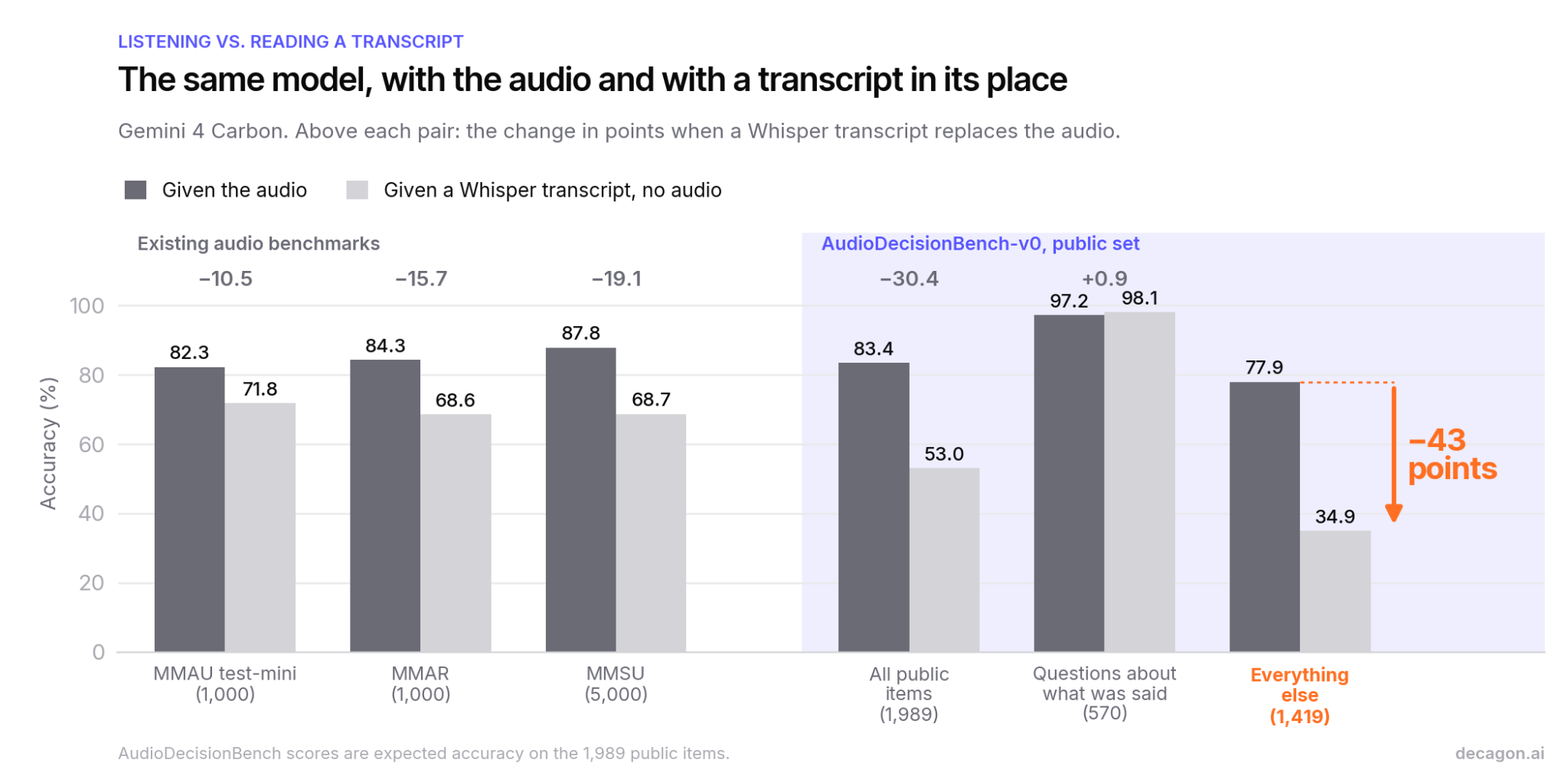
MMAU, MMAR and MMSU are standard audio benchmarks. Each question has about four options, and one of them is always right, so a model never has to say "none of these". Each question also has a single correct answer, so there's no partial credit on subjective ones. And there's no text context besides the question that could change the answer.
They do cover sounds and music as well as speech, but many of their questions don't need much listening. We tested just transcribing them and passing to Gemini 4 Carbon (so no audio at all), and that scored 72% on MMAU test-mini, 69% on MMAR and 69% on MMSU, within 8 points of the best audio decision model on each. On AudioDecisionBench it trails by 36.
How AudioDecisionBench tests them
Any sound. Only a quarter of the items ask what someone said. The rest ask about sound events and scenes, music, coughs and laughter, tone of voice, who's speaking and when things happen. The audio comes from 19 public datasets.
Any input. Every combination appears: the audio decides, the text decides, both are needed, or neither is enough because we removed something the question needs. With all four in the mix, a model can't get by on a habit like "the text always matters". In 360 items the audio and the text actually disagree, and the question says which one to trust.
Groups that change one thing. Many questions come in groups where only one thing changes: the recording, the question or the text. A model gets credit for a group only if it answers every version correctly. That way it can't pass by learning that a certain kind of question usually has a certain answer.
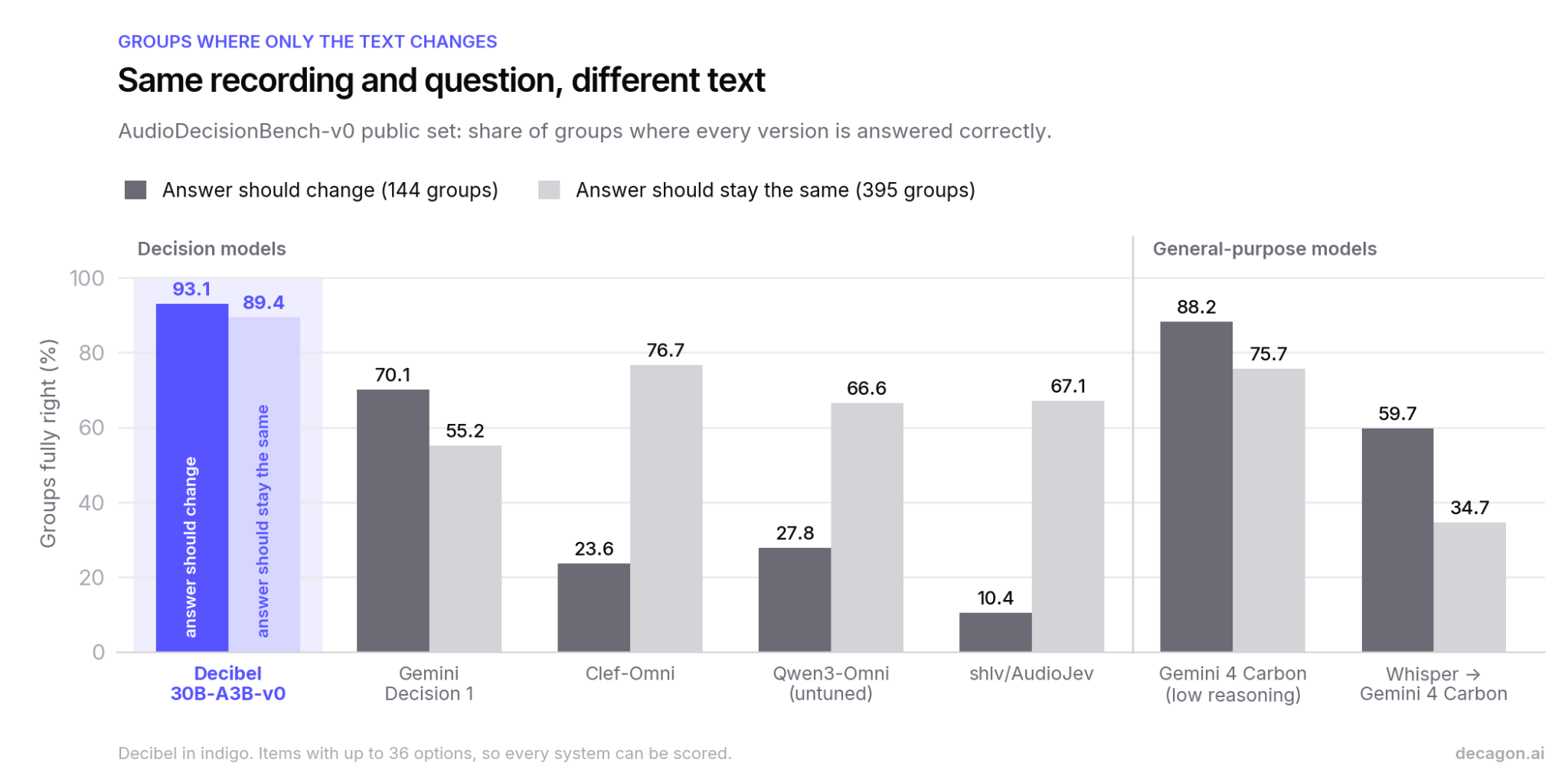
Groups catch models that look fine one item at a time. The untuned Qwen3-Omni gets 65% of the public items right but only 24% of the groups. When only the text changes, Clef-Omni, the untuned Qwen3-Omni and shlv/AudioJev get 24%, 28% and 10% of the groups right. Decibel gets 93%.
A way out. 43% of items include "Something else" as an option. It's the right answer on only about 10% of questions, so a model can't score well by picking it whenever it's unsure.
Partial credit. 701 subjective items are scored against the spread of listener answers. Everything else uses ordinary 0-1 accuracy.
Long option lists. Option lists run from 2 to more than 70 choices.
Decibel-30B-A3B-v0
Decibel-30B-A3B-v0 is a fine-tune of Qwen3-Omni-30B-A3B-Instruct, a 30-billion-parameter model with about 3 billion parameters active per token. Like any Jev-style model, it makes each decision in one forward pass: each option gets a token, and the probabilities come straight from the model's scores for those tokens.
Data construction. Items are built in groups: several questions per recording, and the same question asked about recordings with different answers. The model can't answer from the question alone or from the recording alone, so it has to use both.
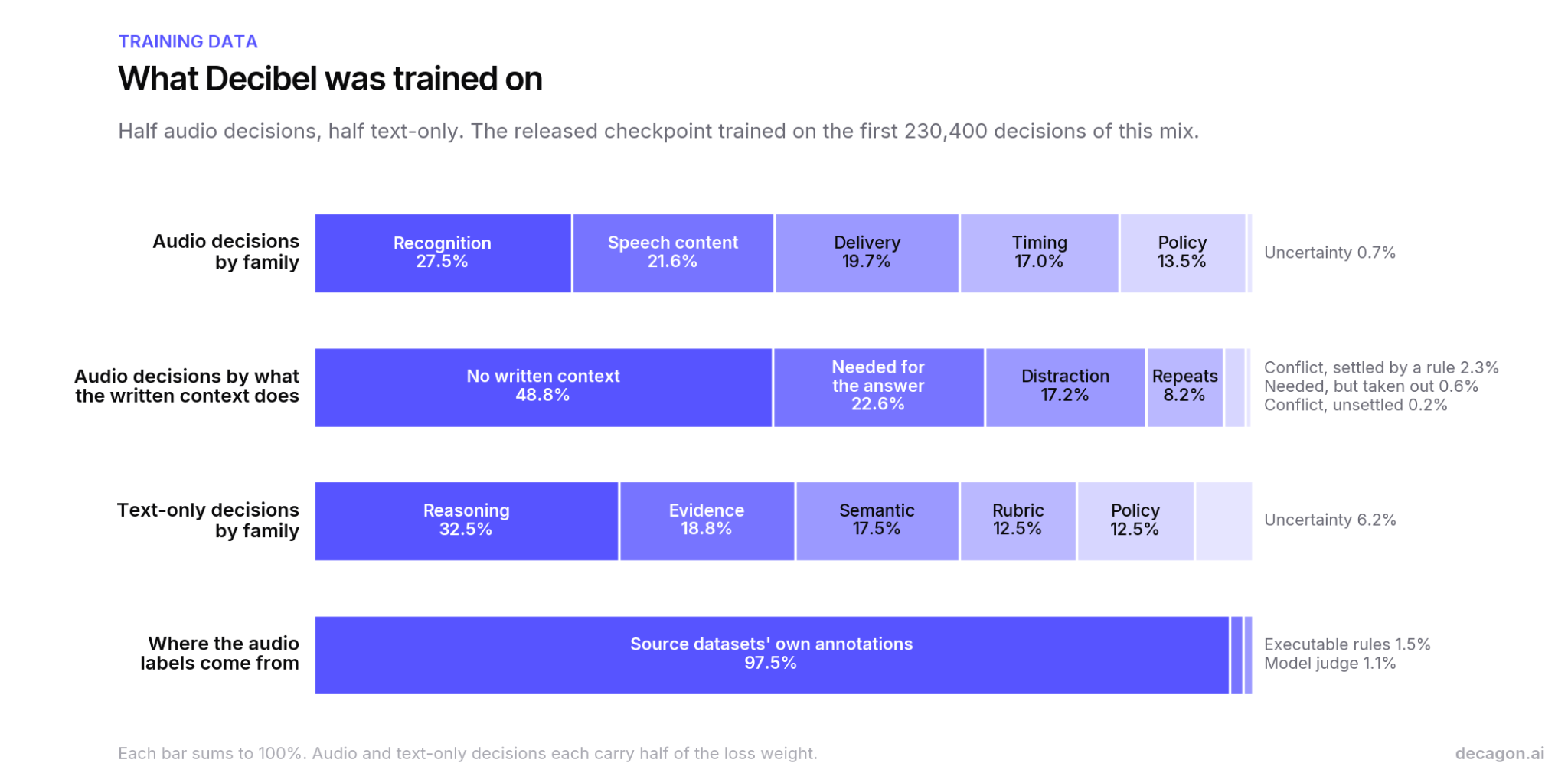
Context roles. 49% of audio decisions have no written context. In the rest, the text is required for the answer (57,817), a distractor (43,997), redundant with the audio (21,050), or in conflict with it, with a written rule that resolves the conflict (5,985). Varying the role teaches the model to judge, for each item, whether the text matters, instead of learning to always follow it or always ignore it.
Text-only data. Half of the training set is text-only, covering reasoning, evidence, policy, rubric and uncertainty tasks. Loss weight is split evenly between audio and text. Decibel should be as good at text-only decisions as at audio ones.
Targets and loss. For subjective items, where listeners chose more than one answer, the target is the share of listeners who picked each option. The loss is cross-entropy plus half a Brier term, with per-example quality weights:
Here is the model's probability for option and is the target. The Brier term penalizes the error on every option, not just the right one, so it rewards calibrated probabilities.
Option order. We didn't train on reordered option lists, but reversing or rotating them only changes Decibel's overall score by at most 0.35 points.
Data volume. The training run is one pass over 230,400 decisions. No segment of source audio appears in more than six training decisions, and 97.5% of audio labels come from the source datasets, with 1% from a model judge.
Results
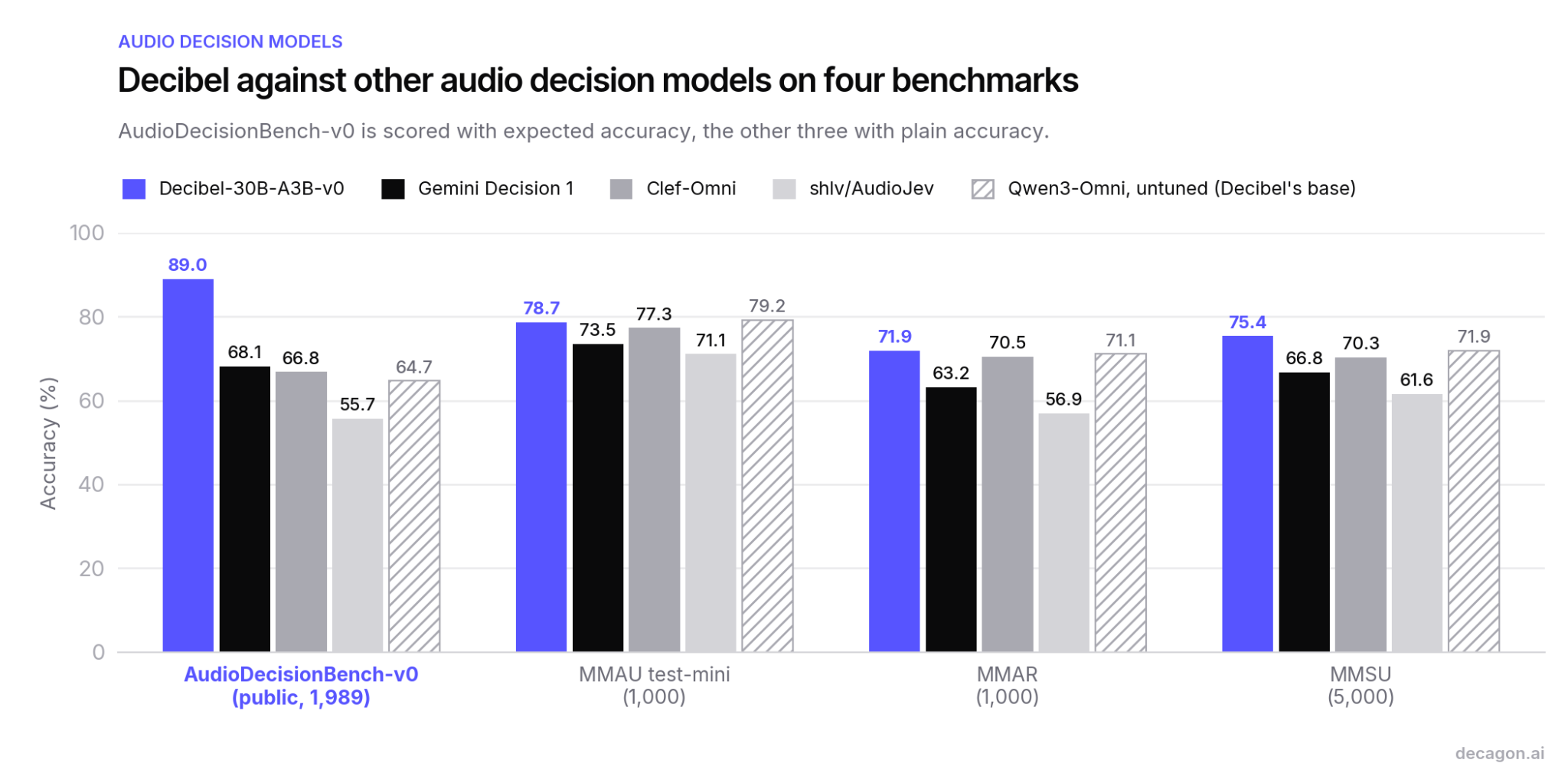
| AudioDecisionBench, public (1,989) | AudioDecisionBench, all (9,989) | Groups fully right (259 public) | MMAU test-mini (1,000) | MMAR (1,000) | MMSU (5,000) | Median time per decision | |
|---|---|---|---|---|---|---|---|
| Decibel-30B-A3B-v0 | 89.0 | 84.4 | 71.0 | 78.7 | 71.9 | 75.4 | 121 ms |
| Gemini Decision 1 | 68.1 | 62.2 | 21.2 | 73.5 | 63.2 | 66.8 | 0.98 s |
| Clef-Omni | 66.8 | 63.2 | 29.7 | 77.3 | 70.5 | 70.3 | 130 ms |
| Qwen3-Omni, untuned | 64.7 | 62.1 | 24.3 | 79.2 | 71.1 | 71.9 | — |
| shlv/AudioJev | 55.7 | 54.8 | 18.5 | 71.1 | 56.9 | 61.6 | 62 ms |
| General-purpose models, not decision models | |||||||
| Gemini 4 Carbon (low reasoning) | 83.4 | 82.3 | 57.9 | 82.3 | 84.3 | 87.8 | 2.9 s |
| Whisper → Gemini 4 Carbon | 53.0 | 49.5 | 22.0 | 71.8 | 68.6 | 68.7 | 5.2 s |
Scores are percentages. On AudioDecisionBench the score is expected accuracy. "Groups fully right" is the share of public groups where every version is answered correctly.
Decibel leads Gemini Decision 1, Clef-Omni and shlv/AudioJev on all four benchmarks. On AudioDecisionBench it's more than 20 points ahead of them and gets more than twice as many groups fully right. Its probabilities are also the most reliable, with a Brier score of 0.14 against 0.39 to 0.67 for the other decision models. When it answers "something else", it's right 93% of the time.
Gemini 4 Carbon, a large general-purpose non-decision model, comes closest on AudioDecisionBench. We're 5.6 points ahead of it on the public set and 2.0 on all 9,989. Some of that lead is home advantage, since our training data was built along the same philosophies as the benchmark (all from different recordings, of course).
Fine-tuning added 24 points over the base model on the AudioDecisionBench public set and nearly tripled the share of groups fully right. MMAU and MMAR stayed within a point, and MMSU rose 3.5.
Where this goes
The four properties are the part of this release we care most about, and none of them is specific to audio. An image decision model also needs to answer any question about the picture, use the text that comes with it, notice when nothing on the list fits, and get credit for answers people disagree on. We'd like to see benchmarks for images and video built around them, and we'll keep extending AudioDecisionBench.
If you build a decision model, we'd love to see how it does! You can score the 1,989 public items yourself. To be scored on all 9,989, email dante.everaert@decagon.ai.
Everything is on Hugging Face, with full details on how we built the benchmark and trained the model:

Start improving your workflow with Decagon
With Decagon, CX teams don’t have to guess whether a change will improve CSAT or deflection. They can move quickly, measure what matters, and act on what works.
Join us
There are very few places where you can prototype with frontier LLMs, ship to production in days, and watch users engage with the systems you built—all while owning the entire stack, from intent parsing and tool usage to API integration and observability. This role at Decagon is one of those places.
From my own experience working across both agent development and broader engineering initiatives at Decagon, I’ve seen firsthand how uniquely impactful this work can be. Whether I’m building intelligent workflows for customers or designing infrastructure that supports our agent platform, it’s rare to find an environment where the work transitions from concept to production within days, actively powering user experiences and transforming how businesses operate.
If you’re looking for a role where you can:
- Build at the frontier of LLMs, automation, and user interaction
- Deploy AI agents that solve high-value business use cases across industries including retail, travel and hospitality, fintech, edtech, and more
- Work directly with customers on high-impact use cases
- Ship fast, iterate constantly, and own your work from idea to production
- Join a fast-moving, collaborative team solving real-world challenges with AI
We’d love to hear from you!


The AI concierge for every customer.