How we taught our agents to recognize other agents
Posted on November 10, 2026

Article
Personal agents are already calling and messaging support teams to book, cancel, price match, and negotiate on a customer’s behalf. Before a business can decide how to handle these conversations, it needs to know who (or what) is on the other end.
Recognizing a personal agent turns out to be a hard technical problem. Deepfake detectors built for clean recordings struggle with phone audio, natural writing makes agents hard to spot in chat, and agent behavior keeps evolving. Existing tools also tend to treat every automated caller as a threat, overlooking agents that are often acting for real customers who need service.
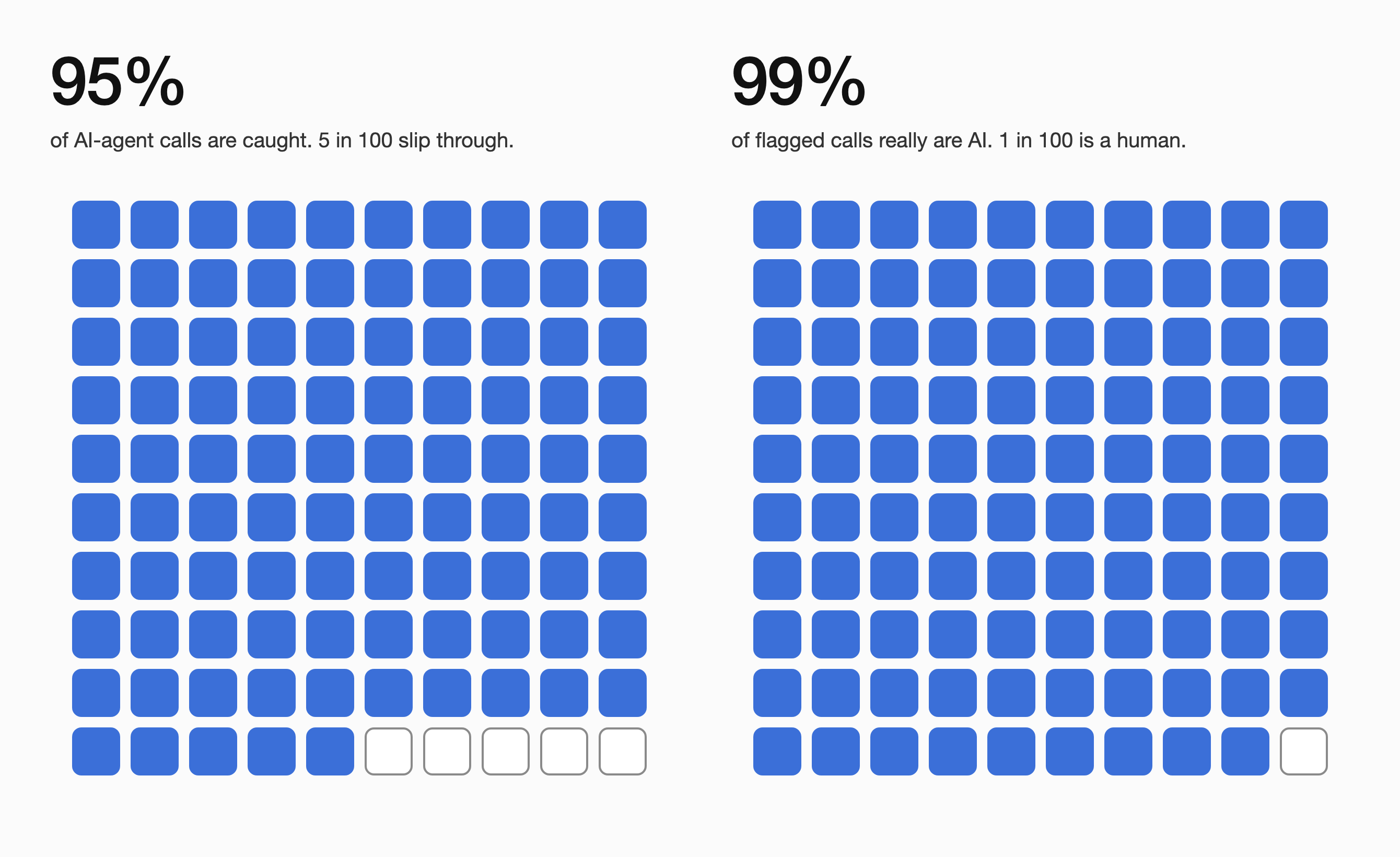
We built our own detection models for voice and chat as part of our Personal Agent Gateway, which combines detection with a dedicated personal agent channel. On held-out phone audio, our voice detector catches 95% of AI voices, returning a verdict in a fraction of a second.
Voice: why we built our own detector
The off-the-shelf deepfake detectors we tested performed little better than chance on phone-quality audio, and some flagged most real callers as fakes. We built our own model, trained on how phone calls actually sound, to check every call in two independent ways:
- Synthetic voice detection assesses whether the caller sounds human or machine-generated using signals across the conversation rather than a single moment, helping to limit false positives.
- Trusted agent recognition matches callers against a curated, continuously reviewed library of known personal AI agents.
On held-out phone audio, the detector catches 95% of AI voices, compared with 73% for a general-purpose multimodal LLM. It also returns a verdict roughly 30× faster than that LLM. Precision exceeds 99%, and businesses can tune sensitivity to their tolerance for false positives, from flagging 1 in 100 real callers to 1 in 2,500.
Chat: how agents type gives them away
Agents write naturally enough that text alone is a poor signal. How they use the chat box is more revealing: text appearing without keystrokes, perfectly regular reply delays, inhuman typing speeds, and pointer movements no human hand would produce. We combine these behavioral signals with a few language cues into a single probability score.
When that score crosses a threshold, the business chooses how to respond: record the detection, end the chat, or ask, “Are you an AI assistant acting on someone’s behalf?” Legitimate agents generally identify themselves when asked. This approach allows us to detect personal agents in chat with 99% precision and 85% recall.
Agents evolve. Detection has to keep up.
Personal agents are getting better at acting human. Within weeks of launch, we watched one agent change how it typed, weakening a signal our detector relied on. As agents become harder to distinguish from people, detection remains an active area of investment for Decagon. We keep retraining our models on new signals as they emerge in production.
It’s also why we invest in partnerships with personal agent providers. A well-intentioned agent that identifies itself through the personal agent channel never needs to be caught. Detection helps businesses recognize those that arrive without an introduction.
From recognizing agents to serving them
Once a business sees agent traffic, the next question is how to serve it. Which actions should an agent be allowed to take? When should it reach a human representative? How should the business handle repeated requests for the same concession? Our guide to serving personal agents offers practical principles for making those decisions.
The Personal Agent Gateway helps businesses put those policies into practice, moving from recognizing agents to serving them through a dedicated channel. Businesses define which workflows agents can use and when to escalate, while verifying what the customer has authorized.
Personal agents will not stay a novelty. Before long, a meaningful share of support conversations will have AI on both sides, making it essential for businesses to recognize agent traffic and choose how to respond now.
Reach out to us to see what personal agent traffic looks like across your channels.

Start improving your workflow with Decagon
With Decagon, CX teams don’t have to guess whether a change will improve CSAT or deflection. They can move quickly, measure what matters, and act on what works.
Join us
There are very few places where you can prototype with frontier LLMs, ship to production in days, and watch users engage with the systems you built—all while owning the entire stack, from intent parsing and tool usage to API integration and observability. This role at Decagon is one of those places.
From my own experience working across both agent development and broader engineering initiatives at Decagon, I’ve seen firsthand how uniquely impactful this work can be. Whether I’m building intelligent workflows for customers or designing infrastructure that supports our agent platform, it’s rare to find an environment where the work transitions from concept to production within days, actively powering user experiences and transforming how businesses operate.
If you’re looking for a role where you can:
- Build at the frontier of LLMs, automation, and user interaction
- Deploy AI agents that solve high-value business use cases across industries including retail, travel and hospitality, fintech, edtech, and more
- Work directly with customers on high-impact use cases
- Ship fast, iterate constantly, and own your work from idea to production
- Join a fast-moving, collaborative team solving real-world challenges with AI
We’d love to hear from you!


The AI concierge for every customer.