Introducing Voice 3 and Chord, our new speech model
Posted on October 1, 2026


Article
Today we're introducing Voice 3, our most advanced voice AI agent yet. Voice 3 launches alongside Personal Agent Gateway, Agent Modules, and Duet Apprentice at Decagon Dialogues.
Voice is the hardest channel to get right and the least forgiving when you don't. Customers notice every interruption and unexplained silence, and the way most voice agents are built makes both likely.
Voice 3 speaks through Chord, the first voice model trained by Decagon Labs specifically for customer conversations. It also now runs on a new duplex architecture that lets the agent listen, speak, and act at the same time. Together, they make conversations more natural and let agents take on more sophisticated, long-running interactions, in any of 70+ languages.
"Customers have been trained for years to speak in short fragments at these IVRs just to get through to a human. The problem is, an LLM can't do its job without real dialogue and context. But with Decagon the voice sounds like it's actually listening, and it keeps the conversation moving instead of going quiet while it works. People start talking to it naturally without even thinking about it. That's what Decagon delivers." - Christian Niedworok, Lead of Digital Service Communication at Deutsche Telekom
Built for a call instead of a script
Most voice agents sound stiff on a live call because the models behind them were built to handle a range of use cases, from narrating a book to voicing over video games, rather than handle the breath, hesitation, and natural pauses of conversation. We built our own model to fine tune the voice specifically for customer conversations.
Chord is our first voice model, developed by Decagon Labs and post-trained on real-world CX conversations. The model shapes speech phrase by phrase, slowing down for a confirmation code or phone number, then returning to a conversational pace, rather than relying on one global speed setting.
Below are three pairs of recordings. In each pair, one voice is a real person and the other is that same voice run through Chord.
Voice 1
Voice 2
Voice 3
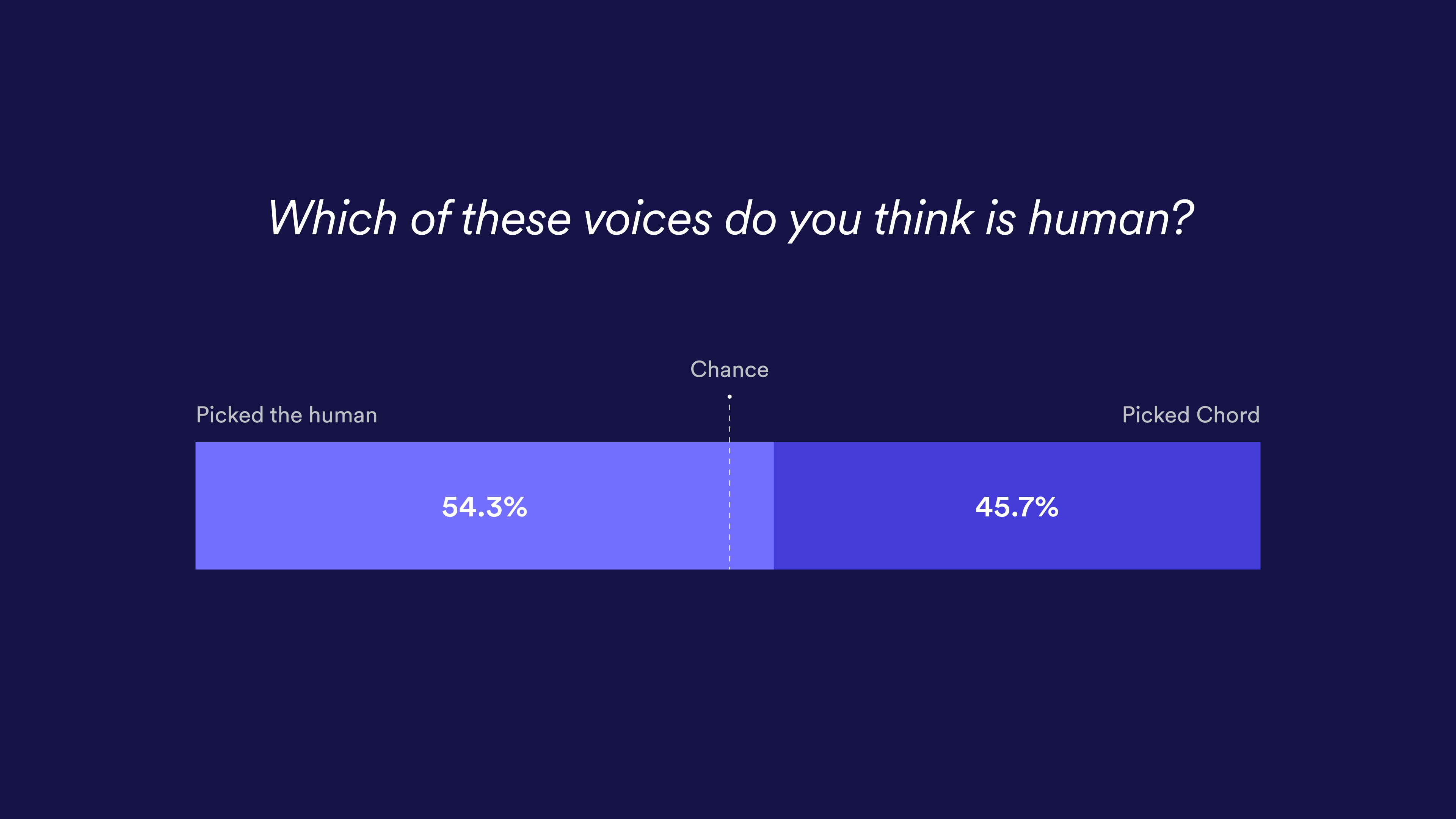
In a blind test across these three voices, we asked listeners to pick the human in each pair. The results showed that on average, approximately 90% of users couldn’t tell.
The familiar controls to customize the voice to your brand also carry over too: voice selection, pronunciation of business-specific terms, and delivery tuned to the business.
Chord is trained on licensed data and consented voice talent, never on customer-owned data. To learn more about Chord, check out this blog.
A conversation shouldn’t stop while the agent works
Most voice agents run on a cascaded pipeline: speech-to-text transcribes the caller, an LLM decides how to respond, and text-to-speech speaks the response. Each stage adds delay, and coordinating them makes natural turn-taking difficult. A simple “mhm” can trigger an interruption, and a long lookup can leave the caller listening to silence. For the end user, that means talking to an agent: telling it what to do, one command at a time.
Voice 3 removes that friction using a new duplex architecture with two layers running in parallel. A low-latency conversational model handles the listening and speaking, from answers to progress updates. A more powerful model handles the reasoning, tool calling, and guardrail enforcement happening behind the conversation.
What this unlocks is an entirely new experience in conversation. Now, you can actually talk with the agent. The agent handles several things at once without losing the thread, so you can ask a follow-up question while it’s still working. It gives quick progress updates when something takes a few seconds, while helping you with other smaller requests. It responds faster, phrases things more naturally, and works with you to figure out what you need.
Decagon Voice sounds local everywhere
Our customers serve people around the world, and every caller should feel like the agent speaks their language. That takes more than translation. Dialect, cultural norms, and local expectations all inform what sounds natural.
Decagon supports 70+ languages without requiring teams to build a separate agent for each. It detects the caller’s language and switches automatically, even when callers move between languages mid-sentence. Locale-specific voices reflect how people speak in each market, and every language is validated by native speakers before it ships.
Specialized intelligence, better conversations
General-purpose models are invaluable when you’re still discovering what a use case requires, but production experience brings the problem into focus. What’s needed then is a model trained to do a particular job exceptionally well.
That’s the philosophy behind Decagon Labs. We continue to build on leading models while developing specialized models for the demands of customer experience. Chord brings the approach to voice, turning what we’ve learned from customer conversations into speech built for them. As agents take on more of the customer journey, that depth of expertise becomes even more valuable.
Want to hear Voice 3 for yourself? Book a demo.

Start improving your workflow with Decagon
With Decagon, CX teams don’t have to guess whether a change will improve CSAT or deflection. They can move quickly, measure what matters, and act on what works.
Join us
There are very few places where you can prototype with frontier LLMs, ship to production in days, and watch users engage with the systems you built—all while owning the entire stack, from intent parsing and tool usage to API integration and observability. This role at Decagon is one of those places.
From my own experience working across both agent development and broader engineering initiatives at Decagon, I’ve seen firsthand how uniquely impactful this work can be. Whether I’m building intelligent workflows for customers or designing infrastructure that supports our agent platform, it’s rare to find an environment where the work transitions from concept to production within days, actively powering user experiences and transforming how businesses operate.
If you’re looking for a role where you can:
- Build at the frontier of LLMs, automation, and user interaction
- Deploy AI agents that solve high-value business use cases across industries including retail, travel and hospitality, fintech, edtech, and more
- Work directly with customers on high-impact use cases
- Ship fast, iterate constantly, and own your work from idea to production
- Join a fast-moving, collaborative team solving real-world challenges with AI
We’d love to hear from you!
.png)


.svg)

.svg)

.svg)

.svg)

.svg)

.svg)

.svg)
The AI concierge for every customer.