Customer experience transformation framework that works
Posted on June 8, 2026


Article
Most companies have a CX strategy, but very few actually see it deliver. In fact, research found that only 6% of brands globally improved their customer experience scores last year, suggesting the gap between ambition and execution is only growing.
In this guide, we’ll break down what it takes to close that gap:
- The four core components of a CX transformation framework.
- The five steps to implement it.
- The financial returns when it’s done well.
- And the common failure patterns that can stall progress before it gets momentum.
What is customer experience transformation
Customer experience transformation is a strategic overhaul of an organization’s culture, technology, and operations to create a genuinely customer-centric operating model. Whereas most CX initiatives focus on improving individual interactions – faster response times, better scripts, a new helpdesk tool – transformation addresses the systems behind them.
This means moving beyond traditional CX improvement concerns like “how do we fix this touchpoint?”, to ask deeper questions, such as: “why does the system produce this outcome, and what needs to change so it doesn’t?” The answers usually sit in team structures, data flows, technology architecture, and how success is measured – not just what frontline agents may say or do.
There are three levels of customer experience:
- The single interaction.
- The cross-channel journey.
- The full customer relationship over time.
Point fixes tend to address the first. CX transformation operates across all three at once, which is why it’s harder to deliver, but also more resilient when correctly executed.
The difference becomes clear in what actually changes. A traditional CX initiative might reduce average handle time or improve first-response rates. A transformation initiative redesigns the journey behind those interactions, reshapes the team responsible for outcomes, unifies the data systems supporting both, and resets how success is measured. Rather than incremental improvement on the current model, the goal is to introduce a new and more effective operating model overall.
Key components of a CX transformation framework
There are three building blocks behind successful CX transformations:
- Defining aspiration and purpose.
- Transforming the business through journey redesign.
- Enabling change through measurement and organizational alignment.
The four pillars below translate those into a practical framework teams can execute against.
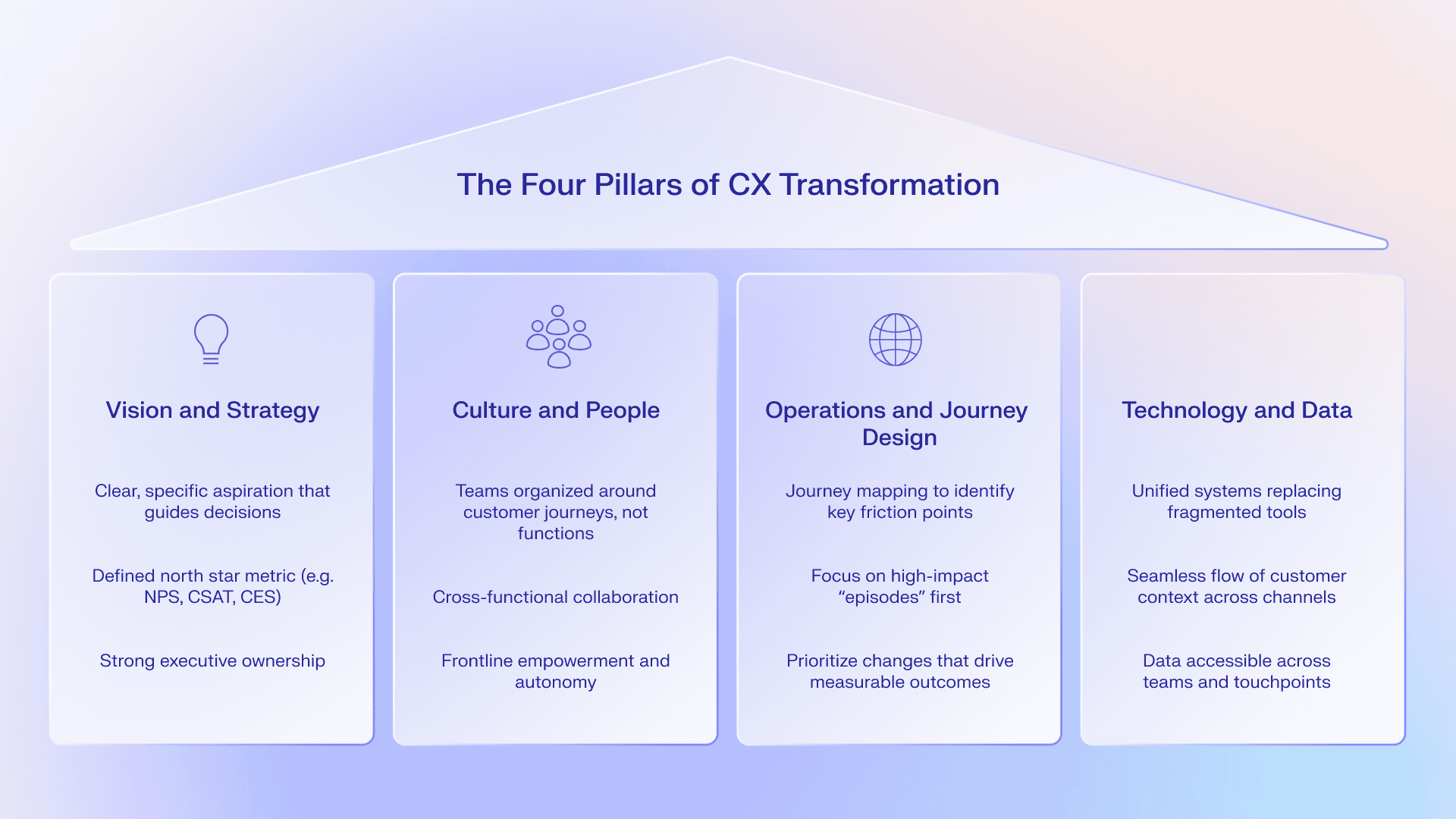
Pillar 1: Vision and strategy
Without a clear aspiration, transformation drifts into incremental change. The vision needs to be specific enough to guide decisions – think of Nike’s focus on inspirational experiences and Starbucks’ commitment to nurturing ones as examples that shape day-to-day operations.
From there, define a north star metric – NPS, CSAT, or Customer Effort Score – that the whole organization tracks, backed by executive sponsorship. Without one metric that leadership owns, CX transformation competes with other priorities and usually falls behind.
Pillar 2: Culture and people
Most CX failures come down to people rather than technology. Research links part of the multi-year decline in CX quality to worsening employee experience – what happens internally shows up in customer interactions.
The structural shift is to organize teams around customer journeys rather than functions. Cross-functional pods with shared accountability behave very differently from siloed teams passing customers between departments. Just as important: give frontline staff the authority to resolve issues without escalation. Autonomy at the point of contact is one of the highest-impact changes an organization can make, with minimal cost beyond the commitment to implement it.
Pillar 3: Operations and journey design
This is where strategy turns into execution. Start with journey mapping to identify moments that drive the most customer friction and internal cost – not all friction matters equally, and not all of it should be addressed first.
Bain recommends focusing on “episodes” rather than entire journeys: high-stakes interactions that disproportionately influence satisfaction or churn. Tackling the most painful episode first, rather than redesigning everything at once, delivers faster results and builds confidence in the transformation. Gaining an understanding of omnichannel support can help map how customer journeys play out across channels in practice.
Pillar 4: Technology and data
Fragmented tools – separate CRM, helpdesk, analytics, and chat systems – mean no team has a complete view of the customer. Context is lost at each handoff, and the experience suffers as a result.
This pillar replaces fragmentation with unified systems where customer context moves seamlessly across interactions. The shift goes beyond consolidating tools; it ensures data is available when and where it’s needed, regardless of channel or team. Many teams are discovering how conversational AI agents can act as a unifying layer to resolve issues, surface context, and maintain continuity in ways disconnected systems cannot.
Benefits and impact of CX transformation
The financial case for CX transformation is well established. The challenge is knowing which figures to rely on, and which KPIs to track once the work is underway.
Customer satisfaction and loyalty
Done well, CX transformation delivers 20 to 30% higher customer satisfaction and 10 to 20% higher employee satisfaction, reflecting how closely internal experience shapes customer outcomes. The revenue impact builds over time: Studies show CX leaders achieve twice the revenue growth of laggards over five years.
Retention and revenue
Retention is where CX investment delivers most directly. A 5% increase in retention can drive 25–95% higher profits, depending on the business model, with subscription companies at the top of that range. From a metrics standpoint, a 7-point increase in NPS typically aligns with around 1% revenue growth – a practical way to link satisfaction scores to financial outcomes.
Cost reduction
The cost case is just as compelling, with gains of 20–50% of the cost base in successful transformations, driven mainly by reduced rework and more efficient operations rather than headcount reduction. AI-powered customer service returns $3.50 for every $1 invested, while $80 billion in global contact center labor savings is projected by the end of 2026.
Which KPIs to track
Measuring CX transformation requires three categories of metrics working in parallel:
- Sentiment:CSAT,NPS, andCustomer Effort Score capture how customers experience the change.
- Operational: First-contact resolution, average handling time, and escalation rate reveal whether the process is actually improving.
- Financial: Lifetime value, cost to serve, and revenue per customer connect CX outcomes to business results.
The key is tracking all three together. If sentiment improves without movement in operational or financial metrics, then although the measurement may have improved, the experience hasn’t. Real transformation shows up across all three.
How to implement customer experience transformation
CX transformation follows a clear sequence. Skipping steps – especially assessment and vision – is one of the fastest ways to invest in costly technology that fails to move the metrics that matter.
Step 1: Assess current state: Start by gathering customer feedback across every channel: support tickets, surveys, reviews, and conversation transcripts. The aim is to pinpoint high-friction moments with enough detail to prioritize effectively. Run this alongside an internal audit of existing technology, team structure, and data flows. This baseline becomes your reference point – without it, you can’t reliably measure progress.
Step 2: Define the vision: Broad aspirations won’t hold up against quarterly pressures. Goals should be specific and tied to outcomes: “increase retention by 15% within 12 months” is actionable; “become more customer-centric” is not. Rather than a committee or a siloed CX team, assign a dedicated transformation leader with real cross-functional authority. When ownership sits in one department, it’s often deprioritized at budget review.
Step 3: Design the experience: Map the end-to-end customer journey, then focus first on the journeys driving the most friction and highest cost to serve.
McKinsey recommends designing “future back”: define the ideal experience, then work backward to identify what needs to change. Plan in 24-month increments with stage gates rather than a single long-term roadmap. Regular checkpoints keep the design responsive to shifting customer behavior and internal capacity.
Step 4: Implement changes: Roll out in focused sprints, starting with one high-impact journey rather than attempting wholesale change. Bain frames this through its CX “factory” model – iterative improvements on discrete customer episodes, each delivering measurable results before the next begins.
On the technology side, deploy AI agents for automated resolution and unified data platforms to maintain cross-channel context. At the same time, restructure teams around redesigned journeys and invest in training for the new operating model – change management is essential here.
Step 5: Measure and optimize: Track the KPIs defined in step 2 against the baseline from step 1, using sentiment, operational, and financial metrics together. Build feedback loops with clear response SLAs so issues surface and are addressed quickly. Optimization is the ongoing work that determines whether the transformation delivers and lasts.
Why CX transformations fail and how to avoid it
Most CX transformations fail because of execution rather than a flawed strategy, and often for the same, avoidable reasons.
Siloed data and departments: When customer data sits across disconnected systems – CRM, helpdesk, billing, marketing automation – no team has a full view of the customer. Interactions happen without context, issues repeat unnoticed, and the experience breaks down at every departmental handoff.
The answer is sequencing: begin with data integration before launching CX initiatives. A shared customer record across teams is foundational, not optional. Without it, CX efforts tend to optimize isolated touchpoints while leaving core disconnections untouched.
Weak executive alignment: When CX sits with a single team – usually support or marketing – it becomes that team’s burden. At quarterly reviews, it competes with broader priorities and loses. Progress stalls because no one with cross-functional authority owns the outcome.
The fix is structural: assign executive ownership with authority across teams, budgets, and systems. A rotating CX committee won’t be effective as a single accountable leader.
Ignoring the human element: Technology investments without change management rarely succeed. Organizations introduce new platforms and expect adoption, without accounting for what changes for frontline staff – shifts in routine, loss of status tied to expertise, and new performance metrics.
Every change in process or technology needs a clear plan that addresses both trade-offs and benefits for employees. Skip this, and you get low adoption, workarounds, and a transformation that exists in systems but not in practice.
The insight-to-action gap: Many organizations gather extensive customer feedback but struggle to act on it. Insights sit in dashboards while operations remain unchanged. When new technology then fails to deliver, confidence in CX investment declines, making future initiatives harder to fund and staff.
The mitigation is twofold: close feedback loops within defined SLAs so insights reliably lead to action, and pilot technology on a single journey before scaling. This gap is where many CX programs can fail. AI agents that deploy in weeks rather than months reduce risk at this stage, delivering visible results before organizational momentum fades.
Where AI agents fit in CX transformation
AI agents are often framed as a customer service tool. In CX transformation, it’s more accurate to see them as the execution layer of the technology pillar, with ripple effects across all four framework components. Automated resolution reshapes operations. Real-time interaction data changes how performance is measured. And when human agents are freed from repetitive volume, the culture pillar can deliver at a higher level.
What AI agents do in practice
The difference from earlier chatbot technology is material. Decision-tree chatbots follow scripted paths. AI agents manage multi-step workflows – processing refunds, updating accounts, managing payment plans – with intelligent escalation when needed. Agentic AI is expected to autonomously resolve 80% of common service issues by 2029 – a reflection of capability growth as much as adoption. Decagon’s capabilities overview shows how this operates in a live enterprise setting.
From cost reduction to experience improvement
The financial case is clear. Gartner projects $80 billion in global contact center labor savings by the end of 2026, with consistently strong returns on AI-powered service investment. But cost savings are only the baseline.
The longer-term impact shows up in CX: 24/7 availability without quality loss, consistent responses at scale, and personalization grounded in real customer history. At the same time, 78% of consumers still want access to a human agent – so the goal is not replacement, but effective routing. Strong deployments use AI where it performs best and escalate when human judgment is required. That’s where AI shifts from cost control to enabling growth.
Connecting AI agents to the framework
AI agents play a role at every stage of the five-step implementation process. In the assess phase, they surface patterns manual analysis often misses – volume spikes, recurring failure points, channel-specific friction. In the implement phase, they automate redesigned journeys rather than legacy ones. In the measure phase, they generate real-time data on resolution, sentiment, and effort, feeding continuous optimization.
Agent Operating Procedures extend this further, allowing non-technical CX teams to define agent behavior in natural language without relying on engineering. This directly strengthens the culture pillar by giving operators control over how AI behaves, rather than waiting on development cycles to reflect changing business logic.
From framework to action plan
The four pillars and five steps are designed to work together, but they don’t need to be applied all at once. A focused starting point works best: select one high-friction journey, apply the framework, measure outcomes, then expand. Organizations that try to transform everything at once tend to slow progress and dilute results.
Sequence matters. Vision comes before design. Assessment comes before implementation. Measurement is built in from the start, not added later. Each step sets up the next.
For teams evaluating where AI agents fit within their transformation, Decagon’s product overview outlines how the AI Agent Engine connects to these framework components – and what deployment looks like in practice for enterprise CX teams.

Start improving your workflow with Decagon
With Decagon, CX teams don’t have to guess whether a change will improve CSAT or deflection. They can move quickly, measure what matters, and act on what works.
Join us
There are very few places where you can prototype with frontier LLMs, ship to production in days, and watch users engage with the systems you built—all while owning the entire stack, from intent parsing and tool usage to API integration and observability. This role at Decagon is one of those places.
From my own experience working across both agent development and broader engineering initiatives at Decagon, I’ve seen firsthand how uniquely impactful this work can be. Whether I’m building intelligent workflows for customers or designing infrastructure that supports our agent platform, it’s rare to find an environment where the work transitions from concept to production within days, actively powering user experiences and transforming how businesses operate.
If you’re looking for a role where you can:
- Build at the frontier of LLMs, automation, and user interaction
- Deploy AI agents that solve high-value business use cases across industries including retail, travel and hospitality, fintech, edtech, and more
- Work directly with customers on high-impact use cases
- Ship fast, iterate constantly, and own your work from idea to production
- Join a fast-moving, collaborative team solving real-world challenges with AI
We’d love to hear from you!
.png)


.svg)

.svg)

.svg)

.svg)

.svg)

.svg)

.svg)
The AI concierge for every customer.